If you find the text too small to read on this website, press the CTRL button and,
without taking your finger off, press the + button, which will enlarge the text.
Keep doing it until you have a comfortable reading size.
(Use the - button to reduce the size)
My knowledge of the Amazon Basin is limited to what I know of Brian Sweeney Fitzgerald, also known as Fitzcarraldo, an opera-loving fortune hunter who dreamt of building an opera house in the Peruvian rainforest, after I watched the movie Fitzcarraldo.
All this changed when I discovered "Komm zurück weisser Bruder" in the Salvos op-shop. I simply had to give it a new home since it was the original German edition which had been meticulously preserved since its publication in 1962, clearly by someone as fond of books as I am.
I had never heard of Theodor Koch-Grünberg whose sudden death in Brazil in 1924 was fictionalised in the 2015 film "El abrazo de la serpiente" (Embrace of the Serpent). It's the kind of book I will take to "Melbourne" to read by the light of a flickering kerosene lantern, far away from all the depressing news of earthquakes, wars, pestilence, and the seemingly never-ending fall of the value of my BHP shares.
I was so pleased having found this book that I bought someone a meal to square the books, so to speak. You can do the same by clicking here.
There was a time when a bishop could not be convicted of a crime unless there were seventy-two witnesses. The degree of proof for a cardinal priest was forty-four, for a cardinal deacon thirty-six, and for a sub-deacon seven witnesses.
Under those rules, they not only had to have committed the crime but also sold tickets. Fortunately, those days are long gone but all religions still enjoy - and demand! - enormous power, influence, and tax breaks.
But in addition to being exempt from all taxes, they also demand to be exempt from mockery and humour, including the one in this commercial by Meat and Livestock Australia which they want to have banned.
No religion - Christian, Jewish, Hindu, Muslim (but especially Muslim!) - should be above society's criticism, challenge or mockery, if they want to be part of that society which, after all, is the source of their power.
Maybe we should offer them a choice: be exempt from mockery or from taxes, but not both. I already know which exemption they'd choose.
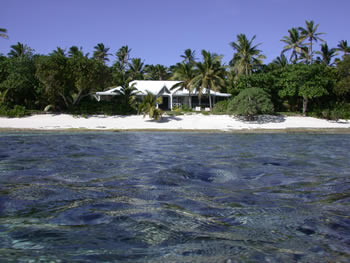
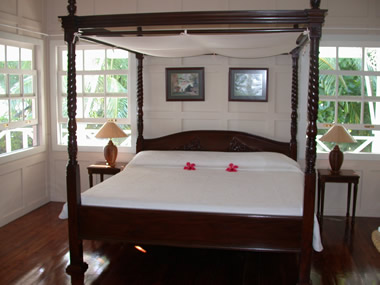
A young couple from Germany who want to remain nameless spent almost a year 'house-sitting' the breathtakingly beautiful boutique hotel VILLA MAMANA on the tiny island of Telekivava'u in the Kingdom of Tonga.
From there they filed articles with some small-town German papers in which they described how they 'lived like Robinson Crusoe for a whole year', tried their hand at 'generating their own solar power' - instead of using the island's two generators - and sweated it out 'growing their own food' - click here.
It makes for great copy but couldn't be further from the truth. The truth is they lived in the lap of luxury in a white villa facing a white sandy beach ...
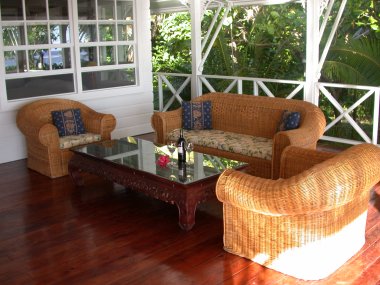
... spent their days reclining on a shady verandah ...
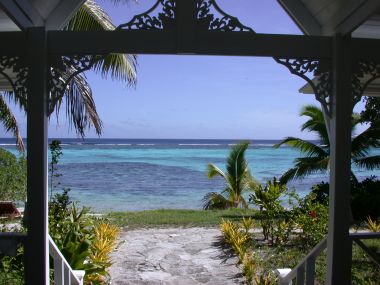
... gazing out to the blue South Pacific ...
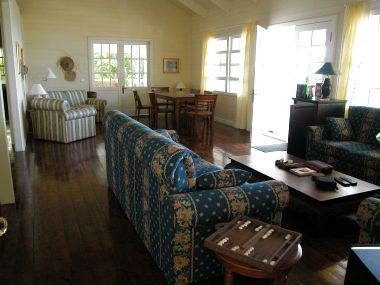
... and their evenings curled up on a soft lounge watching DVDs ...
... or surrounded by imported marble during their quiet moments ...
... before retiring to their four-poster bed.
Needless to say, none of these photos appear in their newspaper reports nor on their blog. Perhaps they realised, having read Daniel Defoe's famous book, that the original Robinson Crusoe did without marble bathrooms and four-poster beds ☺
It's a wet and grey morning and I'm glad I got some lawn-mowing done yesterday. Listening to the radio while having my first cup of tea of the day, I hear someone talk about someone who was only famous for being famous say, "His father died when he was seven years old", which seems like a biological impossibility. I mean, my father was 76 when he died.
Maybe it's because I used to be a German or because I am a pedant - or maybe because of both - but these imprecisions in the English language grate on me. Which makes reading books like "Unbearable Lightness Of Being", written in Czech and then translated into English, so much more fun. The writer, Milan Kundera, finds the insignificance of our lives - the unbearable lightness of being - unbearable and yet, if we act as if our actions are eternally important, then the heaviness of our actions and choices would crush us under their weight.
“And therein lies the whole of man's plight. Human time does not turn in a circle; it runs ahead in a straight line. That is why man cannot be happy: happiness is the longing for repetition.” [I can relate to that.]
“A person who longs to leave the place where he lives is an unhappy person.” [Yes, I can relate to that, too.]
“There is no means of testing which decision is better, because there is no basis for comparison. We live everything as it comes, without warning, like an actor going on cold. And what can life be worth if the first rehearsal for life is life itself? That is why life is always like a sketch. No, 'sketch' is not quite a word, because a sketch is an outline of something, the groundwork for a picture, whereas the sketch that is our life is a sketch for nothing, an outline with no picture.”
“Einmal ist keinmal, says Tomas to himself. What happens but once, says the German adage, might as well not have happened at all. If we have only one life to live, we might as well not have lived at all.”
“Human life occurs only once, and the reason we cannot determine which of our decisions are good and which bad is that in a given situation we can make only one decision; we are not granted a second, third, or fourth life in which to compare various decisions.” [Indeed!]
“Sometimes you make up your mind about something without knowing why, and your decision persists by the power of inertia. Every year it gets harder to change.” [I think we all can relate to that one.]
“Being in a foreign country means walking a tightrope high above the ground without the net afforded a person by the country where he has his family, colleagues, and friends, and where he can easily say what he has to say in a language he has known from childhood.” [Yes, yes, yes!]
If you read deeply enough into this novel you'll start to think, "He’s talking about me!"
Anyway, they also turned the book into a titillating - with emphasis on the first three letters! - movie. I prefer the book! And a cup of tea!
I immediately ordered this well informed, authoritative and illuminating book about the strangest country you probably never visit where men obey Allah and women obey men. Fortunately for men, Allah is distant, but unfortunately for women, men are omnipresent.
Not much seems to have changed since I lived and worked there for a number of years in the early 80s. I, too, had a run-in with the religious police who hit my legs with wooden sticks and told me to go home, not for wearing red nail polish but for wearing a pair of shorts.
Mind you, the religious police is not always just about red nail polish and shorts (a combination I personally haven't tried yet). In 2002, this same bunch of hateful bigoted bastards prevented more than a dozen girls from fleeing their flaming school building in Mecca, thus condemning them to burn to death because, while trying to escape the fire, their abayas and veils didn't fully cover them.
Saudis have a joke that summarises their society's passivity in the face of all this oppression:
The king decides to check the will of his people. So he sets up a checkpoint on a busy road. No one complains. So he asks his security officers to further test people's patience by also doing an identity check at the checkpoint. Still no one complains. Determined to find the public's limit of tolerance, the king asks the officer not only to stop the people and check their identities but also to ticket them. The line of cars grows ever longer on the busy Riyadh road, but still no public complaint emerges from a Saudi. So the king asks the officer to go one step further and slap those he stops, identifies, and tickets. Finally one Saudi man goes ballistic. The ruler asks that his angry countryman be brought before him to explain his outburst. "I have waited for hours in the queue", the man tells the king. "If you are going to do this to us, at least get two officers to slap us so the line moves faster."
Ich wanderte im Jahre 1965 vom (k)alten Deutschland nach Australien aus. In Erinnerung an das alte Sprichwort "Gott hüte mich vor Sturm und Wind und Deutschen die im Ausland sind" wurde ich in 1971 im Dschungel von Neu-Guinea australischer Staatsbürger. Das kostete mich nur einen Umlaut und das zweite n im Nachnamen - von -mann auf -man.
Australien gab mir eine zweite Sprache und eine zweite Chance und es war auch der Anfang und das Ende: nach fünfzig Arbeiten in fünfzehn Ländern - "Die ganze Welt mein Arbeitsfeld" - lebe ich jetzt im Ruhestand in Australien an der schönen Südküste von Neusüdwales.
Ich verbringe meine Tage mit dem Lesen von Büchern, segle mein Boot den Fluss hinunter, beschäftige mich mit Holzarbeit, oder mache Pläne für eine neue Reise.
This blog is written in the version of English that is standard here. So recognise is spelled recognise and not recognize etc. I recognise that some North American readers may find this upsetting, and while I sympathise with them, I sympathise even more with my countrymen who taught me how to spell. However, as an apology, here are a bunch of Zs for you to put where needed.
Zzzzzz
Disclaimer
This blog has no particular axe to grind, apart from that of having no particular axe to grind. It is written by a bloke who was born in Germany at the end of the war (that is, for younger readers, the Second World War, the one the Americans think they won single-handedly). He left for Australia when most Germans had not yet visited any foreign countries, except to invade them. He lived and worked all over the world, and even managed a couple of visits back to the (c)old country whose inhabitants he found very efficient, especially when it came to totting up what he had consumed from the hotels' minibars. In retirement, he lives (again) in Australia, but is yet to grow up anywhere.
He reserves the right to revise his views at any time. He might even indulge in the freedom of contradicting himself. He has done so in the past and will most certainly do so in the future. He is not persuading you or anyone else to believe anything that is reported on or linked to from this site, but encourages you to use all available resources to form your own opinions about important things that affect all our lives and to express them in accordance with Article 19 of the Universal Declaration of Human Rights.
Everything on this website, including any material that third parties may consider to be their copyright, has been used on the basis of “fair dealing” for the purposes of research and study, and criticism and review. Any party who feels that their copyright has been infringed should contact me with details of the copyright material and proof of their ownership and I will remove it.
And finally, don't bother trying to read between the lines. There are no lines - only snapshots, most out of focus.
If you are looking for a particular blog, search here!
Come and read my other blogs (click on triangle for details)