If you find the text too small to read on this website, press the CTRL button and,
without taking your finger off, press the + button, which will enlarge the text.
Keep doing it until you have a comfortable reading size.
(Use the - button to reduce the size)
I've just had one very long and very hot shower in an attempt to warm myself up on this cold and wintry morning. The soap I lathered myself with was the same rich pink which will always remind me of CAMAY soap and my time on Bougainville Island.
During the construction phase of Bougainville Copper in the early 70s when I lived in Camp 6 at Loloho, we received with our weekly towel change a new piece of CAMAY soap, whether we had used up the old one or not. Usually we hadn't and there was CAMAY soap all over the camp.
A certain surveyor working for BECHTEL would collect all the CAMAY soap he could get his hands on and also regularly empty the crib rooms of all their LIPTON tea-bags and ARNOTT'S Scotch Finger biscuits, all of which he would parcel up and regularly send back to his family in Perth.
If you have ever been to Perth and seen a family with a lovely CAMAY complexion and a strong aversion to LIPTON tea and ARNOTT'S Scotch Finger biscuits, you will immediately know whom I am talking about.
Ah, beautiful Bougainville Island! Those days will never CAMAY again!
Click on FULL SCREEN and enjoy! This is a cautionary tale. By the time this movie was made, Paul Eling Johnson had become a bit of a sad sack who still lived on his boat alone, had nobody and no-one and his boat was in a barely floating condition, and he didn't sail anymore. He had found an accepting and non-judgemental community who treated him lovingly and with respect, despite his addiction and often wandering about in an inebriated state. A story of freedom bounded by alcohol and poverty. As the filmmakers stated, "This film is a contemplation about his choices after a lifetime of freedom before he embarked on his final journey of no return."
You know, when you go to youtube.com's front page to search for something and you see a whole list of their latest "suggestions" which you normally ignore and move on from? ("This is the sort of nonsense up with which I will not put", I hear you whisper.)
This morning I was going to type in "Yuval Noah Harari" to see if I could find something about his latest book "Unstoppable Us - How Humans Took Over the World", when I was facing their latest "suggestion" of "The Sailor | Full Movie - What is the price of freedom? Paul Johnson sailed the world all his life. He loved, drank, and lived foolish, never truly living on land. Now he is turning eighty. What is at the end of such a journey? Is there loneliness?", uploaded as recently as Oct 18, 2022.
I hope YouTube won't delete it because, while this world-renowned sailor and builder of boats died in June 2021, aged 83, his legend lives on.
My own sailing-days are well and truly over! The nearest I ever got to casting off completely was in 1974 when I worked for AIR NIUGINI in Port Moresby and saw a wooden yacht, "Spirit of Barbary", advertised for sale at Popondetta on the north coast of New Guinea. An old mate from my Bougainville days, Brian Herde, was also interested, and we flew across to spend a couple of days sailing and living aboard it, after which our minds seemed made up. I had just enough saved up to pay for my half of the boat, but Brian was notoriously reluctant to spend money and to sell even a tiny fraction of his many SANTOS shares, and so the deal was off.
I've had a variety of small sailing boats ever since: in Port Moresby, in Lae, in Honiara, and crewed on boats at Kieta and in Rangoon and Apia and Penang - I even owned a small LASER on Lake Burley Griffin in Canberra! - and until a few years ago sailed my small motor-sailer, the "Lady Anne", on the Clyde River, but now my sailing-days are over!
But I can dream, can't I? And so I keep a large library of sailing books, from Joshua Slocum's "Sailing Alone Around the World" and Francis Chichester's "Gipsy Moth Circles The World" to "The Long Way" by Bernard Moitessier and Robin Knox-Johnston's "A World of My Own".
However, even that library is thinning out as I pass on the books before they become my funeral pyre. One of the lifeguards at the Aquatic Centre, Sam, owns a yacht with her partner, and before they headed north again, I've been feeding them with Alan Lucas's sailing instructions and "Fitting Out Below Decks" and "Fitting Out Above Decks".
No more fitting out for me, but there's still time to watch this most poignant, beautiful film of this amazing sailor whose motto in life was "Never be afraid to be terrified."
Oh, you can kiss me on a Monday
A Monday, a Monday is very, very good
Or you can kiss me on a Tuesday
A Tuesday, a Tuesday, in fact I wish you would
Or you can kiss me on a Wednesday
A Thursday, a Friday and Saturday is best
But never, never on a Sunday
A Sunday, a Sunday, 'cause that's my day of rest
Most any day you can be my guest
Any day you say, but my day of rest
Just name the day that you like the best
Only stay away on my day of rest
Oh, you can kiss me on a cool day, a hot day
A wet day, which everyone you choose
Or try to kiss me on a gray day, a May day
A pay day, and see if I refuse
And if you make it on a bleak day
A freak day, a week day, why you can be my guest
But never, never on a Sunday
Indulge yourself and listen to the soundtracks here
... and I want to be transported back to a time when both the world and I were still young - and decidedly warmer than tonight's "Riverbend".
Greece may still be envisioned by some as old guys in sheets wandering around the Acropolis spouting wisdom before somebody pours hemlock in their ear, but my guess is that they will change their minds after having watched Melina Mercouri do her stuff in "Never on Sunday".
The film is a mix of Pygmalion plus "hooker with a heart of gold", and tells the story of Ilya, a self-employed, free-spirited prostitute who lives in the port of Piraeus in Greece, and Homer, an American tourist and classical scholar who is enamored of all things Greek.
Homer Thrace: She killed them. Medea herself, does she not say, “I killed my children”? Ilya: And you believe her? You don’t understand the women. Medea loves her husband, yes? Homer Thrace: Yes. Ilya: Her husband is interested in another woman? Yes? Homer Thrace: Yes. Ilya: So she said to her husband that she has killed her children to frighten him, to get him back. Homer Thrace: No! Ilya: Yes. She gets him back, and everybody go away and everybody is happy and they go to the seashore. And that’s all! Homer Thrace: If I show you that everything that was ever written about Medea talks of her killing her children. If you ask 10 out of 10 people who saw the play and they tell you it’s true, then by simple logic. . .You’re a Greek, you should be logical. Ilya: Why? Homer Thrace: Because the greatest Greek of them all, Aristotle, invented logic. He said – Ilya: Who? Homer Thrace: Aristotle. . . Ilya: Aristotle! The one that the Captain said thinks men are everything and women are nothing? I don’t care what he said, Aristotle.
Homer Thrace: It's extraordinary. Where do you learn all those languages? Ilya: In bed.
Both Greece’s film industry and the entire nation took centre stage when the film was released in October of 1960, and it led to massive increases in tourism and location-shooting there.
Some twenty years later, I lived and worked in Piraeus by which time Melina Mercouri was already a not-so-sprightly 64 years old. Piraeus was still as lively and, in parts, as bawdy as shown in this movie, but never on Monday when I went back to work in my office at # 3 Agiou Nikolaou to manage my Saudi boss's commodity trading and fleet of bulk carriers.
"And everybody is happy and they go to the seashore." Some memories can get you through even the darkest and stormiest night.
Anyone who recognises me in this photo gets a year's free subscription to this blog
Canberra's Barton House in the sixties was a place for young people or anyone who could not afford more than the weekly £11/10s for a shared room, shared facilties, breakfast and dinner, and a brown-paper-bag full of soggy lunchtime sandwiches. Our average age was well below thirty as you had to be young to survive the late-night drinking and partying.
Pity the retired old surveyor, known as "The Colonel", who lived alone in a room, just him and a copy of every Canberra Times ever printed. He spoke to no-one and yet, if you met him in the corridor, he would stop and stare, daring you to go past him. You could hear him before you saw him as he always carried his own set of cutlery in his pockets. In the mornings he would stand outside the communal showers and rap his walking-stick on the door if anyone dared to stand under the shower for longer than what he considered was a reasonably long enough time.
According to the archives, "The Colonel" - who only ever made it to sergeant - came to Canberra in 1913 to work as surveyor for the Commonwealth. His real name was Ernest John Dowling and he was born in Geelong on 20 March 1891 (which would've made him 74 years old the first time he rapped his walking-stick on my shower cubicle).
Mercifully, he died on 13 August 1971, long before his "home", Barton House, was demolished in 1981. A trig station on a hill near Uriarra in the A.C.T. is named after him, which is more than any of us callous youngsters achieved who so mercilessly made fun of him in the sixties.
Padma is again considering a trip home to Indonesia and took me along for some grocery shopping so that I will know where everything is and where all the specials are while she's away. After all that mental overload, I couldn't help myself but had to take a leek - well, two, actually.
Before he could call the woman with the mob and bucket and the police, I explained to the manager that this was just one of my occasional outbursts of the oxymoronic 'German humour' which had followed me halfway around the world, but all he wanted to know was the meaning of 'oxymoronic'. I told him to ask my friend Des.
To all my old friends from the Bougainville days, this is merely a photographic confirmation that all that lovely CAMAY soap we were given in the camps did nothing for my complexion, and neither have the ravages of time passed me by, so if you run into me at Woolies, you'd probably won't recognise me - unless you see me taking a leek.
They say history repeats itself, and none is more similar to what's happening in Ukraine right now than the eleven-month-long Berlin Airlift when Soviet forces blockaded rail, road, and water access to Allied-controlled areas of Berlin from 24 June 1948 to 12 May 1949.
Yours truly before we were airlifted out of Berlin
I, together with my mother and three sisters, was amongst the 48,000 people that were airlifted out of Berlin during the Russian Blockade. Ours was a freight plane that had landed tons of coal. As soon as the coal had been unloaded, we were flown out to a new life in the West.
Commemorative postage stamp of the Berlin Memorial, first issued on September 1, 1948
The "Notopfer Berlin" postal tax stamp was introduced as a consequence of the Berlin blockade (24 June 1948 – 12 May 1949). The 2 pfennigs that were collected were intended to benefit the West Berlin population who suffered economic hardship. This stamp was in obligatory use until 31.3.1954 but was still used when I began my articled years in 1960.
Maybe Montgomery Clift as pilot Danny MacCullough in "The Big Lift" tells a better story than any documentary ever could:
That was in 1949. Sixteen years later, I made an even better escape to Australia, but you already know of this as I'm still here to tell the tale.
My knowledge of the Amazon Basin is limited to what I know of Brian Sweeney Fitzgerald, also known as Fitzcarraldo, an opera-loving fortune hunter who dreamt of building an opera house in the Peruvian rainforest, after I watched the movie Fitzcarraldo.
All this changed when I discovered "Komm zurück weisser Bruder" in the Salvos op-shop. I simply had to give it a new home since it was the original German edition which had been meticulously preserved since its publication in 1962, clearly by someone as fond of books as I am.
I had never heard of Theodor Koch-Grünberg whose sudden death in Brazil in 1924 was fictionalised in the 2015 film "El abrazo de la serpiente" (Embrace of the Serpent). It's the kind of book I will take to "Melbourne" to read by the light of a flickering kerosene lantern, far away from all the depressing news of earthquakes, wars, pestilence, and the seemingly never-ending fall of the value of my BHP shares.
I was so pleased having found this book that I bought someone a meal to square the books, so to speak. You can do the same by clicking here.
There was a time when a bishop could not be convicted of a crime unless there were seventy-two witnesses. The degree of proof for a cardinal priest was forty-four, for a cardinal deacon thirty-six, and for a sub-deacon seven witnesses.
Under those rules, they not only had to have committed the crime but also sold tickets. Fortunately, those days are long gone but all religions still enjoy - and demand! - enormous power, influence, and tax breaks.
But in addition to being exempt from all taxes, they also demand to be exempt from mockery and humour, including the one in this commercial by Meat and Livestock Australia which they want to have banned.
No religion - Christian, Jewish, Hindu, Muslim (but especially Muslim!) - should be above society's criticism, challenge or mockery, if they want to be part of that society which, after all, is the source of their power.
Maybe we should offer them a choice: be exempt from mockery or from taxes, but not both. I already know which exemption they'd choose.
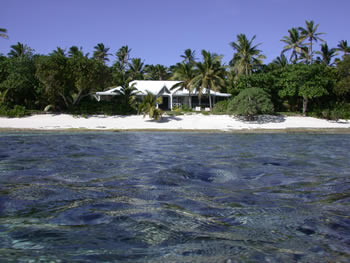
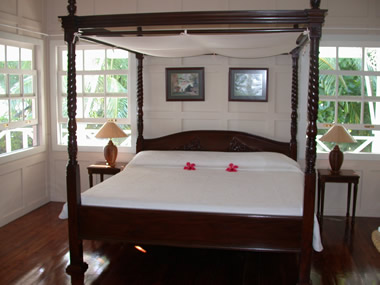
A young couple from Germany who want to remain nameless spent almost a year 'house-sitting' the breathtakingly beautiful boutique hotel VILLA MAMANA on the tiny island of Telekivava'u in the Kingdom of Tonga.
From there they filed articles with some small-town German papers in which they described how they 'lived like Robinson Crusoe for a whole year', tried their hand at 'generating their own solar power' - instead of using the island's two generators - and sweated it out 'growing their own food' - click here.
It makes for great copy but couldn't be further from the truth. The truth is they lived in the lap of luxury in a white villa facing a white sandy beach ...
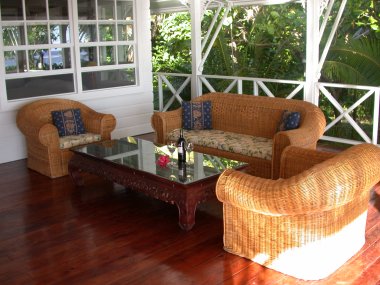
... spent their days reclining on a shady verandah ...
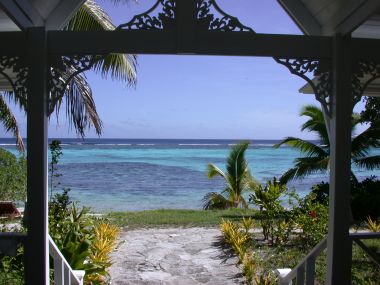
... gazing out to the blue South Pacific ...
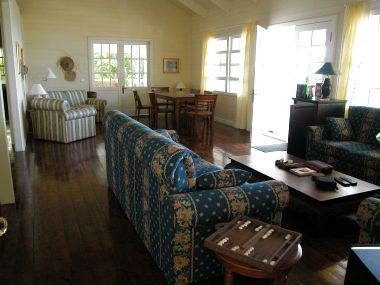
... and their evenings curled up on a soft lounge watching DVDs ...
... or surrounded by imported marble during their quiet moments ...
... before retiring to their four-poster bed.
Needless to say, none of these photos appear in their newspaper reports nor on their blog. Perhaps they realised, having read Daniel Defoe's famous book, that the original Robinson Crusoe did without marble bathrooms and four-poster beds ☺
It's a wet and grey morning and I'm glad I got some lawn-mowing done yesterday. Listening to the radio while having my first cup of tea of the day, I hear someone talk about someone who was only famous for being famous say, "His father died when he was seven years old", which seems like a biological impossibility. I mean, my father was 76 when he died.
Maybe it's because I used to be a German or because I am a pedant - or maybe because of both - but these imprecisions in the English language grate on me. Which makes reading books like "Unbearable Lightness Of Being", written in Czech and then translated into English, so much more fun. The writer, Milan Kundera, finds the insignificance of our lives - the unbearable lightness of being - unbearable and yet, if we act as if our actions are eternally important, then the heaviness of our actions and choices would crush us under their weight.
“And therein lies the whole of man's plight. Human time does not turn in a circle; it runs ahead in a straight line. That is why man cannot be happy: happiness is the longing for repetition.” [I can relate to that.]
“A person who longs to leave the place where he lives is an unhappy person.” [Yes, I can relate to that, too.]
“There is no means of testing which decision is better, because there is no basis for comparison. We live everything as it comes, without warning, like an actor going on cold. And what can life be worth if the first rehearsal for life is life itself? That is why life is always like a sketch. No, 'sketch' is not quite a word, because a sketch is an outline of something, the groundwork for a picture, whereas the sketch that is our life is a sketch for nothing, an outline with no picture.”
“Einmal ist keinmal, says Tomas to himself. What happens but once, says the German adage, might as well not have happened at all. If we have only one life to live, we might as well not have lived at all.”
“Human life occurs only once, and the reason we cannot determine which of our decisions are good and which bad is that in a given situation we can make only one decision; we are not granted a second, third, or fourth life in which to compare various decisions.” [Indeed!]
“Sometimes you make up your mind about something without knowing why, and your decision persists by the power of inertia. Every year it gets harder to change.” [I think we all can relate to that one.]
“Being in a foreign country means walking a tightrope high above the ground without the net afforded a person by the country where he has his family, colleagues, and friends, and where he can easily say what he has to say in a language he has known from childhood.” [Yes, yes, yes!]
If you read deeply enough into this novel you'll start to think, "He’s talking about me!"
Anyway, they also turned the book into a titillating - with emphasis on the first three letters! - movie. I prefer the book! And a cup of tea!
I immediately ordered this well informed, authoritative and illuminating book about the strangest country you probably never visit where men obey Allah and women obey men. Fortunately for men, Allah is distant, but unfortunately for women, men are omnipresent.
Not much seems to have changed since I lived and worked there for a number of years in the early 80s. I, too, had a run-in with the religious police who hit my legs with wooden sticks and told me to go home, not for wearing red nail polish but for wearing a pair of shorts.
Mind you, the religious police is not always just about red nail polish and shorts (a combination I personally haven't tried yet). In 2002, this same bunch of hateful bigoted bastards prevented more than a dozen girls from fleeing their flaming school building in Mecca, thus condemning them to burn to death because, while trying to escape the fire, their abayas and veils didn't fully cover them.
Saudis have a joke that summarises their society's passivity in the face of all this oppression:
The king decides to check the will of his people. So he sets up a checkpoint on a busy road. No one complains. So he asks his security officers to further test people's patience by also doing an identity check at the checkpoint. Still no one complains. Determined to find the public's limit of tolerance, the king asks the officer not only to stop the people and check their identities but also to ticket them. The line of cars grows ever longer on the busy Riyadh road, but still no public complaint emerges from a Saudi. So the king asks the officer to go one step further and slap those he stops, identifies, and tickets. Finally one Saudi man goes ballistic. The ruler asks that his angry countryman be brought before him to explain his outburst. "I have waited for hours in the queue", the man tells the king. "If you are going to do this to us, at least get two officers to slap us so the line moves faster."
"Declared open on 19th April 1987 by Mr Jack Myers an employee engine driver & fireman of the Co. from January 1937 to December 1973."
I discovered this little gem fourteen years ago when we still had our two little dogs Malty and Rover. We had driven to Ulladulla where we strolled along the picturesque harbour to walk off some of the lunch we had overindulged in at the local bowling club: pumpkin soup and a large Fisherman's Basket washed down with a Chardonnay and followed by a slice of cheesecake.
Fourteen years ago when we still had our two little dogs Malty and Rover
Who was Jack Myers? Did he have any dreams and ambitions beyond being an engine-driver and fireman at Mitchell's Mill from January 1937 until December 1973?
Perhaps the point of this tale is Jack Myers' pointless life. Perhaps Jack Myers would've been engine-driver and fireman at that Mill much longer had it not been for the Mill's closure in 1974. Perhaps the highlight of Jack Myers' life is this plaque to his extraordinary ordinariness.
Please don't get me wrong: I am not knocking Jack! Jack and the many millions like him are the red blood cells that hold our society together.
All I know is that nobody is going to put my name on a plaque for having lived the same year thirty-seven times over.
Cancer. It’s a diagnosis that we all dread to hear. But with advances in technology and medicine, more and more people are living better and longer with that dreadful disease.
A recent ABC TV's Catalyst program followed patients experiencing this new kind of cancer care at the Chris O'Brien Lifehouse where, eight years ago, I myself underwent robotic neck and throat surgery under the capable hands of Jonathan Clark and his amazing surgical assistant Cate Froggatt (both of whom you can see in this video clip), and another six weeks of daily radiation administered by Chris Milross's friendly team.
Eight years ago, just minutes before being wheeled in for the seven-hour surgery ...
... and half-way through my intensive radiation, helped along by Nick and Christine
Eight years later, I'm here to tell the tale and to sing the praise of the Lifehouse and thank my personal heroes, Prof. Clark and Prof. Milross.
Ich wanderte im Jahre 1965 vom (k)alten Deutschland nach Australien aus. In Erinnerung an das alte Sprichwort "Gott hüte mich vor Sturm und Wind und Deutschen die im Ausland sind" wurde ich in 1971 im Dschungel von Neu-Guinea australischer Staatsbürger. Das kostete mich nur einen Umlaut und das zweite n im Nachnamen - von -mann auf -man.
Australien gab mir eine zweite Sprache und eine zweite Chance und es war auch der Anfang und das Ende: nach fünfzig Arbeiten in fünfzehn Ländern - "Die ganze Welt mein Arbeitsfeld" - lebe ich jetzt im Ruhestand in Australien an der schönen Südküste von Neusüdwales.
Ich verbringe meine Tage mit dem Lesen von Büchern, segle mein Boot den Fluss hinunter, beschäftige mich mit Holzarbeit, oder mache Pläne für eine neue Reise.
This blog is written in the version of English that is standard here. So recognise is spelled recognise and not recognize etc. I recognise that some North American readers may find this upsetting, and while I sympathise with them, I sympathise even more with my countrymen who taught me how to spell. However, as an apology, here are a bunch of Zs for you to put where needed.
Zzzzzz
Disclaimer
This blog has no particular axe to grind, apart from that of having no particular axe to grind. It is written by a bloke who was born in Germany at the end of the war (that is, for younger readers, the Second World War, the one the Americans think they won single-handedly). He left for Australia when most Germans had not yet visited any foreign countries, except to invade them. He lived and worked all over the world, and even managed a couple of visits back to the (c)old country whose inhabitants he found very efficient, especially when it came to totting up what he had consumed from the hotels' minibars. In retirement, he lives (again) in Australia, but is yet to grow up anywhere.
He reserves the right to revise his views at any time. He might even indulge in the freedom of contradicting himself. He has done so in the past and will most certainly do so in the future. He is not persuading you or anyone else to believe anything that is reported on or linked to from this site, but encourages you to use all available resources to form your own opinions about important things that affect all our lives and to express them in accordance with Article 19 of the Universal Declaration of Human Rights.
Everything on this website, including any material that third parties may consider to be their copyright, has been used on the basis of “fair dealing” for the purposes of research and study, and criticism and review. Any party who feels that their copyright has been infringed should contact me with details of the copyright material and proof of their ownership and I will remove it.
And finally, don't bother trying to read between the lines. There are no lines - only snapshots, most out of focus.
If you are looking for a particular blog, search here!
Come and read my other blogs (click on triangle for details)