If you find the text too small to read on this website, press the CTRL button and,
without taking your finger off, press the + button, which will enlarge the text.
Keep doing it until you have a comfortable reading size.
(Use the - button to reduce the size)
The Mole had been working very hard all the morning, spring-cleaning his little home. First with brooms, then with dusters; then on ladders and steps and chairs, with a brush and a pail of whitewash; till he had dust in his throat and eyes, and splashes of whitewash all over his black fur, and an aching back and weary arms. Spring was moving in the air above and in the earth below and around him, penetrating even his dark and lowly little house with its spirit of divine discontent and longing. It was small wonder, then, that he suddenly flung down his brush on the floor, said ‘Bother!’ and ‘O blow!’ and also ‘Hang spring-cleaning!’ and bolted out of the house without even waiting to put on his coat. Something up above was calling him imperiously, and he made for the steep little tunnel which answered in his case to the gravelled carriage-drive owned by animals whose residences are nearer to the sun and air. So he scraped and scratched and scrabbled and scrooged and then he scrooged again and scrabbled and scratched and scraped, working busily with his little paws and muttering to himself, ‘Up we go! Up we go!’ till at last, pop! his snout came out into the sunlight, and he found himself rolling in the warm grass of a great meadow."
Okay, keep on reading! I know you want to! Click here.
Noel Butler at his saksak house just outside Wewak, taken by Brian Herde at Christmas 1975 when we visited Noel just after I had returned from Burma and before I headed off again to Iran in early 1976.
Back in the days when you almost needed to take out a bank loan to pay for a long-distance telephone call, it wasn't often that I could afford to call my old friend Noel Butler.
He had left New Guinea some time after me but, unlike me, not by choice but with great reluctance as he had always thought to see out his days in New Guinea. Alas, New Guinea's far-too-early Independence in 1975 forced him to leave and the many years away had made him unsuitable for life in his native Australia and he felt isolated and lonely.
Hearing me ask him, "May I speak to the butler of the house?" always resulted in a yeah-I-am-pleased-to-hear-from-you chuckle, even though the time spent on the phone was never long enough. While my budget wouldn't stretch to more than (say) a monthly phone call, we kept up a regular correspondence punctuated by face-to-face meetings in Bundaberg, Caboolture, Brisbane, Mackay, Mt Perry, Sydney, Canberra, and Childers, until his sudden and unexpected death in August 1995.
I was suddenly reminded of this when a kindly soul in Norway, Kåre Vaksvik, emailed me "Is this the correct email address to Peter Goerman ? I have some information that might be interesting for you about Noel Butler
- how I met him in Stratford-on-Avon 1957, and some letters and pictures. Some years ago I googled 'Noel Butler, LAE'. The first 'hit' was your 'And thereby hangs another tale'! Please let me hear if this is your correct address."
And so it came to pass that I received the following photos and letters which allowed me to piece together something of Noel's past because somehow we had always been far too busy and living too much in the moment to talk about what must have been an interesting past for Noel who came to New Guinea as a soldier in WWII and then remained to try his hand at almost anything, including growing coffee in the Highlands.
Noel Butler, Dept. of Works, Lae, Territory of New Guinea, 19/1/58
Dear Kare
You have no idea how pleased I was to receive your letter which was waiting for me when I got back to New Guinea. Thanks also for the photograph. It takes me right back to Bearley at Stratford-on-Avon. I really enjoyed the couple of weeks I spent there and also the people I met.
About my trip, Kare, I had some bad luck. My motor bike just did not seem to be good enough for the trip. I got as far as Split in Yugoslavia, and there I had a lot of trouble with the engine overheating which damaged the engine bearings. I could not get any parts for the bike in Yugoslavia, and as I did not think it was in good enough order for the long journey ahead, I rode back to Italy where I was able to get it fixed up in Trieste. By then my passport visa had expired and I could not re-enter Yugoslavia, so I rode back to England, and later ...
... caught a ship to Australia. I was very sorry to have to turn back as I would very much liked to have done the overland trip.
I did see some of Europe which was all very interesting and strange to me. The route I took was London, Paris, Strasbourg, Stuttgart, Munchen, Salzburg, Villach, Rijeka, Split, Trieste, Venitzia, Pisa, Genova, Nice, Lyon, Bruxelles, Oostende, London, so at least I did see a little of Europe, and enjoyed it very much.
I do hope to return one day and see some more of Europe especially Denmark, Norway and Sweden.
I would certainly like to take part in some skiing and skating. The only time I have ever seen snow was on the Alps in Austria. Now that I am back in the tropical heat of New Guinea England and Europe seem very far off lands. I do not think you would know much about New Guinea in your country, although I think since Holland is having a ...
... dispute with Indonesia over the Dutch half of the island, many more people will have heard of New Guinea. I do not think the Indonesians have any chance of getting it. Mostly the population here is black, and very primitive, some of them even head-hunters but that is in the interior. Lae only has 1500 whites. I have only been back in Lae two weeks. Just now I have no pictures of New Guinea, but I will take some and send them next time I write.
I saw Sputnik II go over Sydney. I had no trouble finding the town of Alisund on a map of Norway. I had heard much about your King Haakon and was sorry to hear of his death. I believe he used to even play tennis. We are very interested in sport in Australia, most likely because we have so much sunshine. I did not like the weather very much in England, but I believe you have plenty of sunshine in ...
... Norway. In New Guinea there is no change of seasons just hot all the year round about 87 degrees Fahrenheit, and very heavy rains.
I will close now wishing you all the best for 1958. I must say your English is very good. I have a few colour slides of New Guinea I am enclosing. You may even have seen them at Stratford-on-Avon.
Cheers and all the best.
Yours sincerely,
Noel Butler.
N.J. Butler, c/o Sub District Office, Wewak, New Guinea. 10/1/62
Dear Kare
It was a very pleasant surprise to be hearing from you once again. Thanks very much for the excellent Christmas card. I feel as if I could do with some of that cold Norway weather. The heat here has been just killing lately. Around the 100 degree F. every day with almost a maximum humidity. The only compensation is that Wewak has some good beaches, so I generally cool off with a swim each day.
I have only been here a few weeks. I think I was at Lae with Dept. of Works when last we exchanged a letter. I had some ups and downs since then. I resigned from my job early last year, ...
... and bought a block of land on the New Guinea Highlands and started planting coffee. I rather enjoyed that life, and the township, KAINANTU, where I have the block, has a very pleasant climate, being situated at an altitude of 5,500 feet. However, it's the same old story. I ran out of money and have had to return to work. However, I still hold the land which has about 8,000 young coffee trees growing on it ...
(Noel was well ahead of his time. Today Kainantu is PNG's coffee-growing centre)
... The job I have here is only very ordinary. I look after the native labour compound for the governments. That means feeding, and paying and generally acting as nursemaid to just over 200 natives housed in the compound.
Wewak (population 500) is the chief town of the Sepik district, and exists solely as a government post.
The whole district which is about the size of England produces nothing except what the 145,000 natives eat themselves. The district has the second largest river in New Guinea, the Sepik, which is always mud coloured, and small ships sail it for 500 miles. Some of the natives along the river are famous for their carvings.
Am enclosing three colour slides which are a pretty poor lot.
Have you been to England again on holidays, or do you go to some other part of Europe. I would certainly like to do a trip over there again, but I think I am more likely to go to Japan in the next year or two.
Well, Kare, I will close off now, wishing you all the best, and hoping for a letter from you.
Sincerely yours, Noel Butler
Two letters and a couple of Christmas cards, all in Noel's impeccable copperplate handwriting and mailed after he had failed in his coffee-planting in the Highlands and joined the Department of Works in Lae before later working for them at Mumeng and then moving to Wewak. And here are the colour slides - remember colour slides? - which Noel had enclosed with his letter.
And how wrong was his comment "... Holland is having dispute with Indonesia over the Dutch half of the island ... I do not think the Indonesians have any chance of getting it", just as most "oldtimers" never expected Papua New Guinea be granted Independence so soon!
And here are the photos Noel received from Kåre:
Kåre at the Bearley Agricultural Holiday Camp in 1957
A group photo at the Bearley Agricultural Holiday Camp with Noel, aged 37, on far left
It was so typical of Noel to have stayed at the Bearley Agricultural Holiday Camp as he did all his travelling on the cheap, not only because he never had much money but also because he would have felt ill at ease hobnobbing it in some fancy hotel. Just to see what this "holiday camp" was all about, I tracked down this video clip:
What a pity Noel didn't stick around long enough to experience the internet - he barely managed a small black-and-white television and never saw a computer, fax machine, video machine, CD- or DVD-player, let alone today's smartphone - and connect up with old acquaintances like friendly Kåre who must be an exceptionally nice guy to have taken all this trouble to send me these things from far-away Norway.
Reminiscing about Bougainville after a hard day's work on the cottage
I was kneedeep in the renovation work on our little guest cottage, when a car drove up, and a chap got out, cast his eyes over all the activities, and casually remarked, "This looks interesting." Annoyed by this intrusion, I briefly looked up and asked, "What is it to you?", suppressing at the last minute a muffled "Dickhead".
Undeterred, the man continued, "Roy is the name. Roy Goldsworthy. How are you, Peter?" Roy Goldsworthy? The Roy Goldsworthy a.k.a "Goldfinger" from my time on Bougainville? I gave the man a second look and, yes, through the ravishes of time I could detect the old debonair, easy-going Roy of almost fifty years ago when we were 'inmates' across the hallway at Camp 1. He'd emailed me some years before - see here - but I hadn't seen him 'in the flesh' since those construction days in 1972.
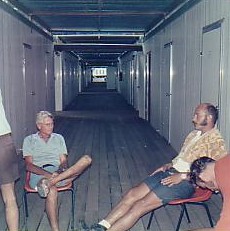
Camp 1 on a (always) rainy Sunday afternoon; the guy in yellow was with Ericssons - what is his name? ; the chap in the lower right corner is Roy "Goldfinger" Goldsworthy fixing up the shoelaces on his thongs!
The always debonair "Goldfinger" - the only man with two dongas: one for himself, one for his ham radio (by the looks he ought to have had a third for his girlfriends!)
What a pleasant surprise! Roy had flown from his home in Kuala Lumpur to Perth for some medical treatment, then across to the east coast to visit Canberra, after which he'd hired a car to come the 120km down the mountain to surprise me!
Roy fixing the wiring
Roy on the right, and my other helper, Troy, on the left
And, still being the same old easy-going Roy, he immediately gave me a hand with the renovations. As an - albeit retired - electrical engineer, his expertise was very much needed for the electrical work and the tricky wiring of an overhead fan. He even fed the not-so-wild ducks in the morning!
With the guest cottage far from being habitable, we bedded him down in the library, but even after his departure three days later he still gave me much-needed advice by email - see here.
The guest cottage is all fixed up now and ready for another visit, Roy! Next time come with Pearly and stay longer so that we can show both of you our beautiful South Coast!
P.S. Since Roy's visit I've had a close look in the mirror myself and I must confess those fifty years have left their marks on me as well. They are a result of living so long and every wrinkle and scar has a story to tell which would be a bestseller if it was ever written down. Lucky for Roy, he still recognised me by my thick German accent.
This booklet from 1948 predates my arrival in Australia by seventeen year but things hadn't changed all that much - or maybe they had because I never even received any booklet during my two-day stay at the reception centre in Bonegilla.
Click on images to enlarge
Some say the kangaroo and emu were chosen to symbolise a nation moving forward. This is based on the common belief that neither animal can move backwards easily.
The booklet ends by suggesting, "There are many things we could tell you but you will have no difficulty in finding them out for yourself."
Yes, there were many more things they could have told us and, no, it wasn't easy finding them out for ourselves but we got there in the end!
P.S. "-- when you're old" on page 15 makes interesting reading:
How things have changed in the meantime! - see the ABC News article "Chifley's time bomb 70 years in the making" of May 2014 - click here.
To summarise: "The National Welfare Fund has long passed into historical obscurity. But the mythology of welfare contributions it engendered remains - one that imagines the welfare state as a giant piggy bank."
Ich wanderte im Jahre 1965 vom (k)alten Deutschland nach Australien aus. In Erinnerung an das alte Sprichwort "Gott hüte mich vor Sturm und Wind und Deutschen die im Ausland sind" wurde ich in 1971 im Dschungel von Neu-Guinea australischer Staatsbürger. Das kostete mich nur einen Umlaut und das zweite n im Nachnamen - von -mann auf -man.
Australien gab mir eine zweite Sprache und eine zweite Chance und es war auch der Anfang und das Ende: nach fünfzig Arbeiten in fünfzehn Ländern - "Die ganze Welt mein Arbeitsfeld" - lebe ich jetzt im Ruhestand in Australien an der schönen Südküste von Neusüdwales.
Ich verbringe meine Tage mit dem Lesen von Büchern, segle mein Boot den Fluss hinunter, beschäftige mich mit Holzarbeit, oder mache Pläne für eine neue Reise.
This blog is written in the version of English that is standard here. So recognise is spelled recognise and not recognize etc. I recognise that some North American readers may find this upsetting, and while I sympathise with them, I sympathise even more with my countrymen who taught me how to spell. However, as an apology, here are a bunch of Zs for you to put where needed.
Zzzzzz
Disclaimer
This blog has no particular axe to grind, apart from that of having no particular axe to grind. It is written by a bloke who was born in Germany at the end of the war (that is, for younger readers, the Second World War, the one the Americans think they won single-handedly). He left for Australia when most Germans had not yet visited any foreign countries, except to invade them. He lived and worked all over the world, and even managed a couple of visits back to the (c)old country whose inhabitants he found very efficient, especially when it came to totting up what he had consumed from the hotels' minibars. In retirement, he lives (again) in Australia, but is yet to grow up anywhere.
He reserves the right to revise his views at any time. He might even indulge in the freedom of contradicting himself. He has done so in the past and will most certainly do so in the future. He is not persuading you or anyone else to believe anything that is reported on or linked to from this site, but encourages you to use all available resources to form your own opinions about important things that affect all our lives and to express them in accordance with Article 19 of the Universal Declaration of Human Rights.
Everything on this website, including any material that third parties may consider to be their copyright, has been used on the basis of “fair dealing” for the purposes of research and study, and criticism and review. Any party who feels that their copyright has been infringed should contact me with details of the copyright material and proof of their ownership and I will remove it.
And finally, don't bother trying to read between the lines. There are no lines - only snapshots, most out of focus.
If you are looking for a particular blog, search here!
Come and read my other blogs (click on triangle for details)