If you find the text too small to read on this website, press the CTRL button and,
without taking your finger off, press the + button, which will enlarge the text.
Keep doing it until you have a comfortable reading size.
(Use the - button to reduce the size)
Watch the full-length movie "Joyeux Noël" online on YouTube.
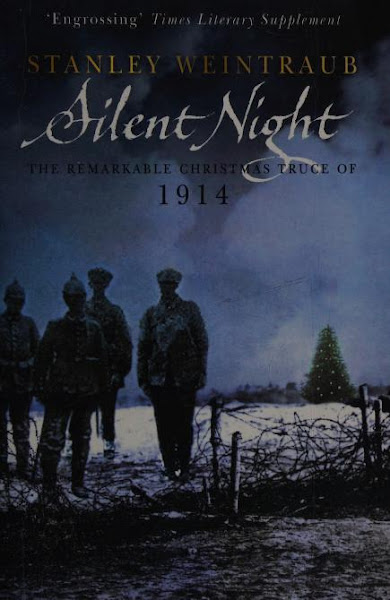
During World War I, in the winter of 1914, on the battlefields of Flanders, one of the most unusual events in all of human history took place. The Germans had been in a fierce battle with the British and French. Both sides were dug in, safe in muddy, man-made trenches six to eight feet deep that seemed to stretch forever.
All of a sudden, German troops began to put small Christmas trees, lit with candles, outside of their trenches. Then, they began to sing songs. Across the way, in the “no man’s land” between them, came songs from the British and French troops. Incredibly, many of the Germans, who had worked in England before the war, were able to speak good enough English to propose a Christmas truce.
The British and French troops, all along the miles of trenches, accepted. In a few places, allied troops fired at the Germans as they climbed out of their trenches. But the Germans were persistent and Christmas would be celebrated even under the threat of impending death.
According to Stanley Weintraub, who wrote about this event in his book, "Silent Night", "signboards arose up and down the trenches in a variety of shapes. They were usually in English, or – from the Germans – in fractured English. Rightly, the Germans assumed that the other side could not read traditional gothic lettering, and that few English understood spoken German. ‘YOU NO FIGHT, WE NO FIGHT’ was the most frequently employed German message. Some British units improvised ‘MERRY CHRISTMAS’ banners and waited for a response. More placards on both sides popped up."
A spontaneous truce resulted. Soldiers left their trenches, meeting in the middle to shake hands. The first order of business was to bury the dead who had been previously unreachable because of the conflict.
Then, they exchanged gifts. Chocolate cake, cognac, postcards, newspapers, tobacco. In a few places, along the trenches, soldiers exchanged rifles for soccer balls and began to play games.
It didn’t last forever. In fact, some of the generals didn’t like it at all and commanded their troops to resume shooting at each other. After all, they were in a war. Soldiers eventually did resume shooting at each other. But only after, in a number of cases, a few days of wasting rounds of ammunition shooting at stars in the sky instead of soldiers in the opposing army across the field.
For a few precious moments there was peace on earth and good will toward men. All because the focus was on Christmas. Happens every time. There’s something about Christmas that changes people. It happened over 2000 years ago in a little town called Bethlehem. It’s been happening over and over again down through the years of time.
War es der Roman des Erich Maria Remarques oder die Kurzgeschichte vom Heinrich Böll, die aus mir einen Auswanderer machten? Ich las sie als Klassenkameraden noch die Abenteuergeschichten des Karl Mays lasen.
Obwohl ich jetzt vergessen habe, welches von den beiden ich zuerst las, habe ich beide Bücher noch vor meinen Augen: "Im Westen Nichts Neues" war ein gebundenes Bertelsmann-Buch und Heinrich Bölls Geschichte "Wanderer, kommst du nach Spa ..." war in einem rororo-Taschenbuch.
Selbst die frühere 1930 Verfilmung von "Im Westen Nichts Neues" trug nichts dazu bei den Aufstieg dieser Charlie-Chaplin-Figur und einen neuen Krieg zu verhindern. In 1965 wurde ich Wehrdienstverweiderer und sagte ihnen wo sie sich den nagelneuen Wehrpass stecken können.
Und seither lebe ich in Frieden auf der südlichen Halbkugel der Welt.
For some reason the English subtitles disappear from the embedded video; so unless you're fluent in Chinese, you may have to watch it on YouTube instead by clicking here.
Under the Dome stayed online in China for about a week during which time it was viewed more than one hundred million times. And then, without any explanation, the authorities scrubbed it from the Chinese internet.
We are fortunate not to live in a dictatorship and are allowed to view this documentary, complete with English subtitles. It should be required viewing because pollution knows no borders and whatever China dumps into the air and ocean will catch up with us eventually, despite all our own efforts and self-imposed costs to clean up our own environment.
Without China cleaning up its act, our efforts may all be for naught. What's "How dare you!" in Chinese? Maybe Greta should learn Chinese!
I heard this story from Auggie Wren. Since Auggie doesn't come off too well in it, at least not as well as he'd like to, he's asked me not to use his real name. Other than that, the whole business about the lost wallet and the blind woman and the Christmas dinner is just as he told it to me.
Auggie and I have known each other for close to eleven years now. He works behind the counter of a cigar store on Court Street in downtown Brooklyn, and since it's the only store that carries the little Dutch cigars I like to smoke, I go in there fairly often. For a long time, I didn't give much thought to Auggie Wren. He was the strange little man who wore a hooded blue sweatshirt and sold me cigars and magazines, the impish, wisecracking character who always had something funny to say about the weather, the Mets or the politicians in Washington, and that was the extent of it.
But then one day several years ago he happened to be looking through a magazine in the store, and he stumbled across a review of one of my books. He knew it was me because a photograph accompanied the review, and after that things changed between us. I was no longer just another customer to Auggie, I had become a distinguished person. Most people couldn't care less about books and writers, but it turned out that Auggie considered himself an artist. Now that he had cracked the secret of who I was, he embraced me as an ally, a confidant, a brother-in-arms. To tell the truth, I found it rather embarrassing. Then, almost inevitably, a moment came when he asked if I would be willing to look at his photographs. Given his enthusiasm and goodwill, there didn't seem any way I could turn him down.
God knows what I was expecting. At the very least, it wasn't what Auggie showed me the next day. In a small, windowless room at the back of the store, he opened a cardboard box and pulled out twelve identical photo albums. This was his life's work, he said, and it didn't take him more than five minutes a day to do it. Every morning for the past twelve years, he had stood on the corner of Atlantic Avenue and Clinton Street at precisely seven o'clock and had taken a single color photograph of precisely the same view. The project now ran to more than four thousand photographs. Each album represented a different year, and all the pictures were laid out in sequence, from January 1 to December 31, with the dates carefully recorded under each one.
As I flipped through the albums and began to study Auggie's work, I didn't know what to think. My first impression was that it was the oddest, most bewildering thing I had ever seen. All the pictures were the same. The whole project was a numbing onslaught of repetition, the same street and the same buildings over and over again, an unrelenting delirium of redundant images. I couldn't think of anything to say to Auggie, so I continued turning pages, nodding my head in feigned appreciation. Auggie himself seemed unperturbed, watching me with a broad smile on his face, but after he'd seen that I'd been at it for several minutes, he suddenly interrupted and said, "You're going too fast. You'll never get it if you don't slow down."
He was right, of course. If you don't take the time to look, you'll never manage to see anything. I picked up another album and forced myself to go more deliberately. I paid closer attention to the details, took note of the shifts in weather, watched for the changing angles of light as the seasons advanced. Eventually I was able to detect subtle differences in the traffic flow, to anticipate the rhythm of the different days (the commotion of workday mornings, the relative stillness of weekends, the contrast between Saturdays and Sundays). And then, little by little, I began to recognize the faces of the people in the background, the passers-by on their way to work, the same people in the same spot every morning, living an instant of their lives in the field of Auggie's camera.
Once I got to know them, I began to study their postures, the way they carried themselves from one morning to the next, trying to discover their moods from these surface indications, as if I could imagine stories for them, as if I could penetrate the invisible dramas locked inside their bodies. I picked up another album. I was no longer bored, no longer puzzled as I had been at first. Auggie was photographing time, I realized, both natural time and human time, and he was doing it by planting himself in one tiny corner of the world and willing it to be his own, by standing guard in the space he had chosen for himself. As he watched me pore over his work, Auggie continued to smile with pleasure. Then, almost as if he'd been reading my thoughts, he began to recite a line from Shakespeare.
"Tomorrow and tomorrow and tomorrow," he muttered under his breath, "time creeps on its petty pace." I understood then that he knew exactly what he was doing.
That was more than two thousand pictures ago. Since that day, Auggie and I have discussed his work many times, but it was only last week that I learned how he acquired his camera and started taking pictures in the first place. That was the subject of the story he told me, and I'm still struggling to make sense of it.
Earlier that same week, a man from the New York Times called me and asked if I would be willing to write a short story that would appear in the paper on Christmas morning. My first impulse was to say no, but the man was very charming and persistent, and by the end of the conversation I told him I would give it a try. The moment I hung up the phone, however, I fell into a deep panic. What did I know about Christmas? I asked myself. What did I know about writing short stories on commission?
I spent the next several days in despair, warring with the ghosts of Dickens, O.Henry, and other masters of the Yuletide spirit. The very phrase "Christmas story" had unpleasant associations for me, evoking dreadful outpourings of hypocritical mush and treacle. Even at their best, Christmas stories were no more than wish-fulfillment dreams, fairy tales for adults, and I'd be damned if I'd ever allowed myself to write something like that. And yet, how could anyone propose to write an unsentimental Christmas story? It was a contradiction in terms, an impossibility, an out-and-out conundrum. One might just as well imagine a racehorse without legs, or a sparrow without wings.
I got nowhere. On Thursday I went out for a long walk, hoping the air would clear my head. Just past noon, I stopped in at the cigar store to replenish my supply, and there was Auggie, standing behind the counter as always. He asked me how I was. Without really meaning to, I found myself unburdening my troubles to him. "A Christmas story?" he said after I had finished. "Is that all? If you buy me lunch, my friend, I'll tell you the best Christmas story you ever heard. And I guarantee that every word of it is true."
We walked down the block to Jack's, a cramped and boisterous delicatessen with good pastrami sandwiches and photographs of old Dodgers teams hanging on the walls. We found a table in the back, ordered our food, and then Auggie launched into his story.
"It was the summer of seventy-two," he said. "A kid came in one morning and started stealing things from the store. He must have been about nineteen or twenty, and I don't think I've ever seen a more pathetic shoplifter in my life. He's standing by the rack of paperbacks along the far wall and stuffing books into the pockets of his raincoat. It was crowded around the counter just then, so I didn't see him at first. But once I noticed what he was up to, I started to shout. He took off like a jackrabbit, and by the time I managed to get out from behind the counter, he was already tearing down Atlantic Avenue. I chased after him for about half a block, and then I gave up. He'd dropped something along the way, and since I didn't feel like running any more, I bent down to see what it was.
"It turned out to be his wallet. There wasn't any money inside, but his driver's license was there along with three or four snapshots. I suppose I could have called the cops and had him arrested. I had his name and address from the license, but I felt kind of sorry for him. He was just a measly little punk, and once I looked at those pictures in his wallet, I couldn't bring myself to feel very angry at him. Robert Goodwin. That was his name. In one of the pictures, I remember, he was standing with his arm around his mother or grandmother. In another one he was sitting there at age nine or ten dressed in a baseball uniform with a big smile on his face. I just didn't have the heart. He was probably on dope now, I figured. A poor kid from Brooklyn without much going for him, and who cared about a couple of trashy paperbacks anyway?
"So I held on to the wallet. Every once in a while I'd get a little urge to send it back to him, but I kept delaying and never did anything about it. Then Christmas rolls around and I'm stuck with nothing to do. The boss usually invites me over to his house to spend the day, but that year he and his family were down in Florida visiting relatives. So I'm sitting in my apartment that morning feeling a little sorry for myself, and then I see Robert Goodwin's wallet lying on a shelf in the kitchen. I figure what the hell, why not do something nice for once, and I put on my coat and go out to return the wallet in person.
"The address was over in Boerum Hill, somewhere in the projects. It was freezing out that day, and I remember getting lost a few times trying to find the right building. Everything looks the same in that place, and you keep going over the same ground thinking you're somewhere else. Anyway, I finally get to the apartment I'm looking for and ring the bell. Nothing happens. I assume no one's there, but I try again just to make sure. I wait a little longer, and just when I'm about to give up, I hear someone shuffling to the door. An old woman's voice asks who's there, and I say I'm looking for Robert Goodwin. 'Is that you, Robert?' the old woman says, and then she undoes about fifteen locks and opens the door.
"She has to be at least eighty, maybe ninety years old, and the first thing I notice about her is that she's blind. 'I knew you'd come, Robert,' she says. 'I knew you wouldn't forget your Granny Ethel on Christmas.' And then she opens her arms as if she's about to hug me.
"I didn't have much time to think, you understand. I had to say something real fast, and before I knew what was happening, I could hear the words coming out of my mouth. 'That's right, Granny Ethel,' I said. 'I came back to see you on Christmas.' Don't ask me why I did it. I don't have any idea. Maybe I didn't want to disappoint her or something, g, I don't know. It just came out that way, and then this old woman was suddenly hugging me there in front of the door, and I was hugging her back.
"I didn't exactly say I was her grandson. Not in so many words, at least, but that was the implication. I wasn't trying to trick her, though. It was like a game we'd both decided to play - without having to discuss the rules. I mean, that woman knew I wasn't her grandson Robert. She was old and dotty, but she wasn't so far gone that she couldn't tell the difference between a stranger and her own flesh and blood. But it made her happy to pretend, and since I had nothing better to do anyway, I was happy to go along with her.
"So we went into the apartment and spent the day together. The place was a real dump, I might add, but what can you expect from a blind woman who does her own housekeeping? Every time she asked me a question about how I was, I would lie to her. I told her I found a good job working in a cigar store, I told her I was about to get married, I told her a hundred pretty stories, and she made like she believed every one of them. 'That's fine, Robert,' she would say, nodding her head and smiling. 'I always knew things would work out for you.'
"After a while, I started getting pretty hungry. There didn't seem to be much food in the house, so I went out to a store in the neighborhood and brought back a mess of stuff. A precooked chicken, vegetable soup, a bucket of potato salad, a chocolate cake, all kinds of things. Ethel had a couple of bottles of wine stashed in her bedroom, and so between us we managed to put together a fairly decent Christmas dinner. We both got a little tipsy from the wine, I remember, and after the meal was over we went out to sit in the living room, where the chairs were more comfortable. I had to take a pee, so I excused myself and went to the bathroom down the hall. That's where things took yet another turn. It was ditsy enough doing my little jig as Ethel's grandson, but what I did next was positively crazy, and I've never forgiven myself for it.
"I go into the bathroom, and stacked up against the wall next to the shower, I see a pile of six or seven cameras. Brand-new thirty-five-millimeter cameras, still in their boxes, top-quality merchandise. I figure this is the work of the real Robert, a storage place for one of his recent hauls. I've never taken a picture in my life, and I've certainly never stolen anything, but the moment I see those cameras sitting in the bathroom, I decide I want one of them for myself. Just like that. And without even stopping to think about it, I tuck one of those boxes under my arm and go back to the living room.
"I couldn't have been gone for more than three minutes, but in that time Granny Ethel had fallen asleep in her chair. Too much Chianti, I suppose. I went into the kitchen to wash the dishes, and she slept through the whole racket, snoring like a baby. There didn't seem any point in disturbing her, so I decided to leave. I couldn't even write a note to say goodbye, seeing that she was blind and all, so I just left. I put her grandson's wallet on the table, picked up the camera again, and walked out of the apartment. And that's the end of the story."
"Did you ever go back to see her?" I asked.
"Once," he said. "About three or four months later. I felt so bad about stealing the camera, I hadn't even used it yet. I finally made up my mind to return it, but Ethel wasn't there any more. I don't know what happened to her, but someone else had moved into the apartment, and he couldn't tell me where she was."
"She probably died."
"Yeah, probably."
"Which means that she spent her last Christmas with you."
"I guess so. I never thought of it that way."
"It was a good deed, Auggie. It was a nice thing you did for her."
"I lied to her, and then I stole from her. I don't see how you can call that a good deed."
"You made her happy. And the camera was stolen anyway. It's not as if the person you took it from really owned it."
"Anything for art, eh, Paul?"
"I wouldn't say that. But at least you put the camera to good use."
"And now you've got your Christmas story, don't you?"
"Yes," I said. "I suppose I do."
I paused for a moment, studying Auggie as a wicked grin spread across his face. I couldn't be sure, but the look in his eyes at that moment was so mysterious, so fraught with the glow of some inner delight, that it suddenly occurred to me that he had made the whole thing up. I was about to ask him if he'd been putting me on, but then I realized he'd never tell. I had been tricked into believing him, and that was the only thing that mattered. As long as there's one person to believe it, there's no story that can't be true.
"You're an ace, Auggie," I said. "Thanks for being so helpful."
"Any time," he answered, still looking at me with that maniacal light in his eyes. "After all, if you can't share your secrets with your friends, what kind of a friend are you?"
"I guess I owe you one."
"No you don't. Just put it down the way I told it to you, and you don't owe me a thing."
"Except the lunch."
"That's right. Except the lunch."
I returned Auggie's smile with a smile of my own, and then I called out to the waiter and asked for the check.
The short story has no Santa Claus, no Christmas tree, and no brightly wrapped packages. And yet there's plenty of giving. Merry Christmas!
After having eaten 365 bowls of porridge and 365 pawpaws for breakfast; after having fed the ducks and the resident possum 365 times; after having taken 365 afternoon naps on the verandah; after having watched the evening news 365 times; after having drunk countless cups of tea and slightly fewer glasses of wine and read even slightly fewer books; and before capping off each day by listening to Late Night Live at ten past ten 261 times (Phillip Adams broadcasts only from Monday to Friday); we are again to celebrate an event that started with the immaculate conception in Mary's womb of someone called Jesus on March the 25th, and finished bang on time nine months later - a miracle in itself! - in a year which no one is certain about, and others claim to have never happened at all.
Also right bang on time I'm about to have my annual bath and change of underwear - another miracle! - because, YES, IT'S CHRISTMAS AGAIN!!!
Ich wanderte im Jahre 1965 vom (k)alten Deutschland nach Australien aus. In Erinnerung an das alte Sprichwort "Gott hüte mich vor Sturm und Wind und Deutschen die im Ausland sind" wurde ich in 1971 im Dschungel von Neu-Guinea australischer Staatsbürger. Das kostete mich nur einen Umlaut und das zweite n im Nachnamen - von -mann auf -man.
Australien gab mir eine zweite Sprache und eine zweite Chance und es war auch der Anfang und das Ende: nach fünfzig Arbeiten in fünfzehn Ländern - "Die ganze Welt mein Arbeitsfeld" - lebe ich jetzt im Ruhestand in Australien an der schönen Südküste von Neusüdwales.
Ich verbringe meine Tage mit dem Lesen von Büchern, segle mein Boot den Fluss hinunter, beschäftige mich mit Holzarbeit, oder mache Pläne für eine neue Reise.
This blog is written in the version of English that is standard here. So recognise is spelled recognise and not recognize etc. I recognise that some North American readers may find this upsetting, and while I sympathise with them, I sympathise even more with my countrymen who taught me how to spell. However, as an apology, here are a bunch of Zs for you to put where needed.
Zzzzzz
Disclaimer
This blog has no particular axe to grind, apart from that of having no particular axe to grind. It is written by a bloke who was born in Germany at the end of the war (that is, for younger readers, the Second World War, the one the Americans think they won single-handedly). He left for Australia when most Germans had not yet visited any foreign countries, except to invade them. He lived and worked all over the world, and even managed a couple of visits back to the (c)old country whose inhabitants he found very efficient, especially when it came to totting up what he had consumed from the hotels' minibars. In retirement, he lives (again) in Australia, but is yet to grow up anywhere.
He reserves the right to revise his views at any time. He might even indulge in the freedom of contradicting himself. He has done so in the past and will most certainly do so in the future. He is not persuading you or anyone else to believe anything that is reported on or linked to from this site, but encourages you to use all available resources to form your own opinions about important things that affect all our lives and to express them in accordance with Article 19 of the Universal Declaration of Human Rights.
Everything on this website, including any material that third parties may consider to be their copyright, has been used on the basis of “fair dealing” for the purposes of research and study, and criticism and review. Any party who feels that their copyright has been infringed should contact me with details of the copyright material and proof of their ownership and I will remove it.
And finally, don't bother trying to read between the lines. There are no lines - only snapshots, most out of focus.
If you are looking for a particular blog, search here!
Come and read my other blogs (click on triangle for details)