If you find the text too small to read on this website, press the CTRL button and,
without taking your finger off, press the + button, which will enlarge the text.
Keep doing it until you have a comfortable reading size.
(Use the - button to reduce the size)

Today's quote:

Sunday, February 2, 2025

"Let me through, my brother is a doctor!"


Remember that scene in "The Best Exotic Marigold Hotel" where Sonny yells out, "Let me through, my brother is a doctor!"? I am reminded of it every time I talk to one of my neighbours whose son is a doctor but who seems to know more about medical conditions than his own son.

This morning he looked at Padma's earlobes and told her about Frank's sign, a diagonal ear lobe crease (DELC) which some studies suggest indicates a greater risk for coronary artery disease. Before you all rush off to inspect your earlobes in the bathroom mirror, listen to Dr Google:

"Frank's sign, also known as a diagonal earlobe crease, is considered to have modest accuracy when it comes to predicting cardiovascular disease (CVD) as a standalone marker; while studies show an association, its sensitivity and specificity are not high enough to rely on it alone for diagnosis, meaning it should be used alongside other established risk factors for CVD. "

What a relief! Perhaps there's still time left to watch once more this movie which has become one of our favourites and which we have watched again and again. Unfortunately, YouTube only has its trailer:


Googlemap Riverbend


The Painted Veil


I had read W. Somerset Maugham's book "The Painted Veil" long before it had been made into this, the third and most beautiful movie adaptation, filmed in China with support from the China government, and long before the book had been reprinted with a scene from the movie as its cover, which I find a bit dishonest; after all, the book had been written long before the movie.


Read the book online here
or listen to the audiobook here


"The Painted Veil" is a love story set in the 1920s that tells the story of a young English couple, Walter, a middle class doctor and Kitty, an upper-class woman, who get married for the wrong reasons and relocate to Shanghai, where she falls in love with someone else. When he uncovers her infidelity, in an act of vengeance, he accepts a job in a remote village in China ravaged by a deadly epidemic, and takes her along. Their journey brings meaning to their relationship and gives them purpose in one of the most remote and beautiful places on earth.

The title is a reference to Percy Bysshe Shelley's 1824 sonnet, which begins "Lift not the painted veil which those who live / Call Life".


The book and the movie have different endings; in particular, the movie leaves out the phrase, "The dog it was that died", which is the key to the story, if you recognise it as the allusion to Oliver Goldsmith's poem "An Elegy On The Death Of A Mad Dog" which ends with the last two lines, "The man recovered of the bite / The dog it was that died".

This hauntingly beautiful movie will stay with you for a long time; much longer than the surprising two years it has already been freely available on YouTube without any copyright challenge. Watch it while you can!


Googlemap Riverbend


Saturday, February 1, 2025

Have you ever been back to where you grew up?


Cyriaksring 47


Me neither, but these days you can find anything on the internet, and here was the very same Council flat in which I spent the first three of my eight school years, the formative years when the world around me was beginning to make some sense, and it was now advertised for sale at €147,000.


Sales Advertisement

The word 'Reserviert' could in this context be translated as 'Under Offer'


3-room apartment for sale €147,000 77 m²
38118 Braunschweig, Cyriaksring 47

The well-maintained "Luisenhof" unit complex has been gradually renovated over the years and has developed into a popular and sought-after residential complex for young and old. This well-designed 3-room apartment is on the 2nd floor of the six-unit building on the Cyriaksring. The spacious hallway has a storage cupboard in which all sorts of things can be stored. The kitchen is quite large and offers enough space for a dining area. The small pantry with window adjacent to the kitchen is practical. The large balcony, which is accessed from the kitchen, offers beautiful views of the outdoor area below. The bathroom is located next the bedroom. It has a toilet, sink, and a bathtub with shower partition. The bedroom is large enough for two wardrobes. On the opposite side of the hallway is the living room which opens up to another room that can be used as a dining room or study. The apartment is in need of some renovations.

The wooden windows are double-glazed. The walls are wallpapered. The floors in the hallway and in the living and dining room as well as in the bedroom are carpeted. The kitchen has PVC flooring. The bathroom is tiled three-quarters up the wall, with tiles on the floor. The heating is gas-fired with the gas boiler is in the kitchen. All rooms have panel radiators.

The unit is centrally located, with shopping centres, doctors, pharmacies, bakers, hairdressers, restaurants, banks, etc. just a few minutes' walk away, as is the city of Braunschweig. If you don't want to walk, you can take the tram which is nearby, as is the bus connection. There is also a good connection to the motorways in all directions.

The monthly maintenance fee of currently €183 includes chimney sweeping, garbage collection, street cleaning, winter service, associated insurance, rainwater drainage, water/sewerage, caretaker, garden maintenance, window cleaning, and other operating costs.

See original advertisement


We lived in this rented apartment at Cyriaksring 47 in the 1950s: my father, my stepmother, my stepsister Karin, my stepbrother Borkhardt, two other tenants that the Department of Social Housing always kept assigning to us, and I. A mere 77 square meters for seven people!

Those were the post-war years: housing shortages, unemployment, little money and little to eat. We were some of the lucky ones who had our own apartment, but we always had to share it with some tenants.

The three-story building belonged to the ALLIANZ insurance company and was part of the so-called "Luisenhof", which was built in 1938. It is now listed under the National Trust and the units are owner-occupied.

The view of the "Luisenhof" from the kitchen, bathroom and bedroom is still the same as it was back then, although balconies have been added and instead of frames for beating the dust out of the carpets (we had no vacuum cleaners then), there are now children's swings. And despite the housing shortages, there were no attics under the roofs then either.


The view of the "Luisenhof"


The entrance opens up into a hallway and to the right is the kitchen ...


The hallway; to the left is the kitchen


... while straight ahead and to the right is the bedroom in which we all slept: my father, my stepmother, my stepsister Karin, my stepbrother Borkhardt, and I. My oldest sister Margaret and my older brother Karl-Heinz had already escaped the dysfunctional family, but where were my two sisters Bärbel und Monika? That would've been nine people in 77 m²!


The hallway; to the left is the "big" living room, to the right is the bedroom


One small bedroom for five people. How did we all fit in??? (with difficulty!)


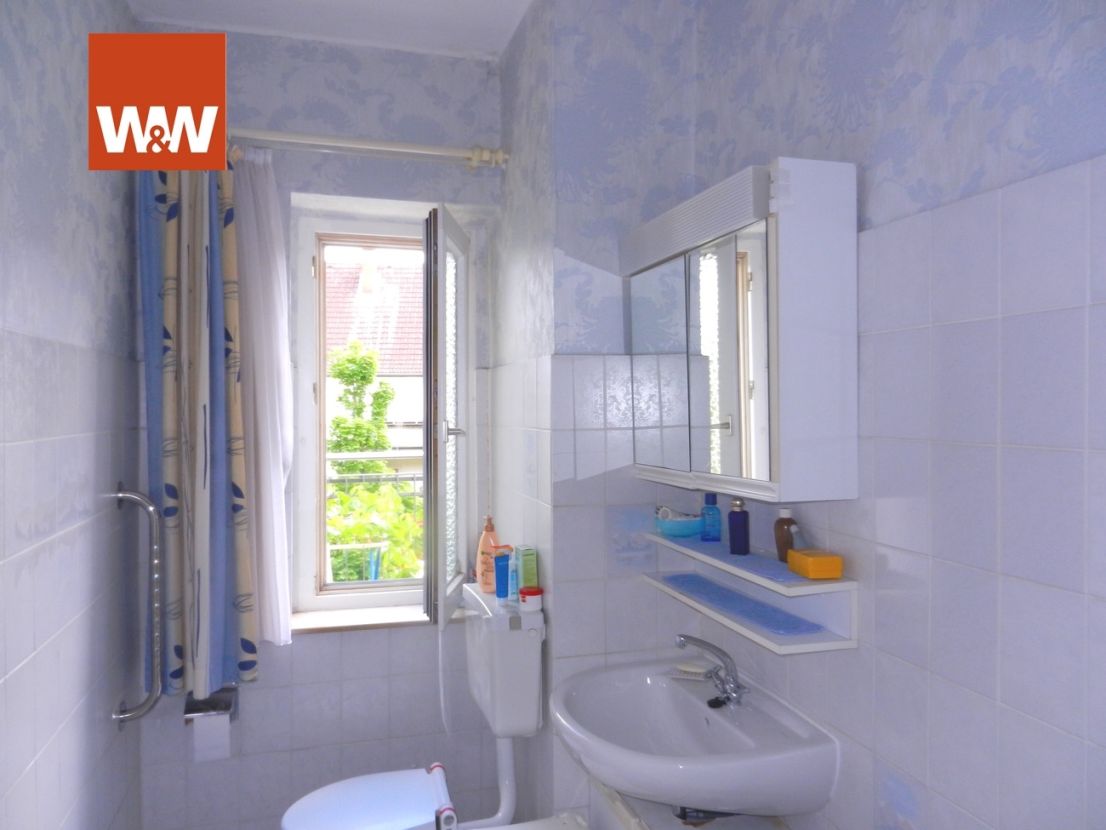
The bathroom is also the loo which, with seven people (or was it nine?), was always occupied. The wall-mounted hotwater system is no longer there. The gas had to be lit with a match to heat the water. Everything else seems just as it was then, except the holder for the toilet paper which was a luxury in those days; instead, we used the previous day's newspaper which I cut into small pieces. That's how I learnt to read.


The renovated bathroom


The kitchen has since been renovated and now also has a balcony, but the built-in pantry in the left-hand corner is still there. Back then we didn't have a refrigerator nor a washing machine but there was always the huge wood-fired boiler in the basement for the weekly laundry.


The renovated kitchen with the new balcony

The balcony which wasn't there in my days


The "big" living room was lived in by our tenants who kept changing on a regular basis. I still remember two zither-playing Bavarians who played at a local beerhall (the Harry Lime theme is still in my ears but, luckily, there was no "Third Man"). I also still remember a young couple who stayed with us. The pretty wife always wore a very transparent negligee which helped me enormously in getting top marks at school in biology.


The "big" living room


The smaller sitting room, or "gute Stube", was strictly for visitors, and children were not allowed in it. All our activities took place in the kitchen which was always warm with all the cooking; there we ate, did our home work, built our own simple toys, and played LUDO in winter. Eleven square metres per person! We were poor but we didn't know it!


The "gute Stube"


Thank you very much, W&W, for the memories, and thanks for having saved me the money on a QANTAS-ticket to see it again one last time.


The T(r)opic of Cancer


left-to-right: Douglas Murray, Richard Dawkins, Lawrence Krauss, Stephen Fry


I have never met Christopher Hitchens, but when I heard that he had died in December 2011 at the far-too-young age of 62 of oesophageal cancer, I felt like I had lost a friend. He was an intellectual giant, the likes of which we will never see again.

In a Vanity Fair piece published in 2010, titled "Topic of Cancer", he recognised the long-term prognosis was far from positive and he would be a "very lucky person to live another five years". Here is the article:


Topic of Cancer

"I have more than once in my time woken up feeling like death. But nothing prepared me for the early morning last June when I came to consciousness feeling as if I were actually shackled to my own corpse. The whole cave of my chest and thorax seemed to have been hollowed out and then refilled with slow-drying cement. I could faintly hear myself breathe but could not manage to inflate my lungs. My heart was beating either much too much or much too little. Any movement, however slight, required forethought and planning. It took strenuous effort for me to cross the room of my New York hotel and summon the emergency services. They arrived with great dispatch and behaved with immense courtesy and professionalism. I had the time to wonder why they needed so many boots and helmets and so much heavy backup equipment, but now that I view the scene in retrospect I see it as a very gentle and firm deportation, taking me from the country of the well across the stark frontier that marks off the land of malady. Within a few hours, having had to do quite a lot of emergency work on my heart and my lungs, the physicians at this sad border post had shown me a few other postcards from the interior and told me that my immediate next stop would have to be with an oncologist. Some kind of shadow was throwing itself across the negatives."


To continue reading the article, click here.


Googlemap Riverbend


The true story of a lone genius who solved the greatest scientific problem of his time


Anyone alive in the eighteenth century would have known the "the longitude problem" was the thorniest scientific dilemma of the day - and had been for centuries. Lacking the ability to measure their longitude, sailors throughout the great ages of exploration had been literally lost at sea as soon as they lost sight of land. Thousands of lives, and the increasing fortunes of nations, hung on a resolution.

The quest for a solution had occupied scientists and their patrons for the better part of two centuries when, in 1714, Parliament upped the ante by offering a king's ransom (£20,000) to anyone whose method or device proved successful. Countless quacks weighed in with preposterous suggestions. The scientific establishment throughout Europe - from Galileo to Sir Isaac Newton - had mapped the heavens in both hemispheres in its certain pursuit of a celestial answer. In stark contrast, one man, John Harrison, dared to imagine a mechanical solution - a clock that would keep precise time at sea, something no clock had ever been able to do on land.

"Longitude" is the dramatic human story of an epic scientific quest, and of Harrison's forty-year obsession with building his perfect timekeeper, known today as the chronometer. Full of heroism and chicanery, brilliance and the absurd, it is also a fascinating brief history of astronomy, navigation, and clockmaking.


Longitude is the measurement east or west of the prime meridian that runs through Greenwich, England. Half of the world, the Eastern Hemisphere, is measured in degrees east of the prime meridian. The other half, the Western Hemisphere, in degrees west of the prime meridian. Degrees of longitude are divided into 60 minutes. Each minute of longitude can be further divided into 60 seconds. For example, the longitude of Paris, France, is 2° 29' E (2 degrees, 29 minutes east). The longitude for Brasilia, Brazil, is 47° 55' W (47 degrees, 55 minutes west). A degree of longitude is about 111 kilometers (69 miles) at its widest. The widest areas of longitude are near the Equator, where Earth bulges out. Because of Earth's curvature, the actual distance of a degrees, minutes, and seconds of longitude depends on its distance from the Equator. The greater the distance, the shorter the length between meridians. All meridians meet at the North and South Poles.


I picked up this beautifully turned-out hardcover edition of Dava Sobel's book at my favourite op-shop for a mere gold coin. I already have one copy, and this one is not for myself but for one of the lifeguards at the Aquatic Centre who with her partner will go a-sailing again in May on their yacht presently moored at Yorkey's Knob just north of Cairns.

Of course, they have a Global Positioning Sydney (GPS) on board which gives them their position on the ocean within metres at the press of a button. For all I know, they may not even know the meaning of latitude and longitude but they will after they've read "Longitude".


And so will you after you've read this book online at www.archive.org.


Googlemap Riverbend