If you find the text too small to read on this website, press the CTRL button and,
without taking your finger off, press the + button, which will enlarge the text.
Keep doing it until you have a comfortable reading size.
(Use the - button to reduce the size)

Today's quote:

Saturday, October 31, 2026

Die gibt's immer noch!


Vieles hat sich in Deutschland seit meiner Abreise in 1965 sehr verändert - oder besser gesagt, sehr verschlechtert - aber anscheinend gibt es diese alten Litfaßsäulen immer noch.

Vor unserer Etagenwohnung in Braunschweig am Cyriaksring 47 stand damals solch eine Säule und als Kinder warteten wir immer gespannt auf den Mann der jede zweite oder dritte Woche mit seinem Fahrrad kam dass hoch belastet war mit Plakaten, einem großen Eimer voll mit Kleister, und einem langen Besen mit dem er dann den Kleister auf die Säule schmierte und danach die neuen Plakate anklebte und abglättete. (Und da dies ein 'blog' über Deutschland und in deutscher Sprache ist, verwende ich auch typische seitenlange deutsche Schachtelsätze.)

Ich erinnerte mich später wieder an die Litfaßsäule als ich den Film 'Der Dritte Mann' sah, in dem Harry Lime seinen Verfolgern entkommt wenn er in eine Litfaßsäule verschwindet die in die Abwässerkanäle führt.


Heute erinnerte ich mich noch einmal daran als ich das unterige Foto auf der facebook-Seite meiner alten Heimatstadt Brauschweig sah, denn dort stand immer noch eine dieser Litfaßsäulen auf dem Fußweg vor den Mietkasernen. In einer solcher Mietkaserne war ich aufgewachsen und wäre vielleicht auch noch alt geworden, hätte ich nicht mein Glück gesucht (und auch gefunden) in Australien. Glück braucht der Mensch!


Zu meiner Zeit gab es noch nicht so viele Privatautos.
Man ging zu Fuß oder nahm den Bus oder die Straßenbahn.
Photo courtesy www.unsere-alten-zeiten.de


Aber ich bin dennoch froh dass es diese alten Litfaßsäulen noch gibt.


Googlemap Riverbend


Next time is next time; now is now.


A haiku is a traditional form of short Japanese poetry that captures a single fleeting moment in time, often focusing on nature and simplicity. You know, something like master poet Matsuo Bashō's "An old silent pond... A frog jumps into the pond, Splash! Silence again."

"Perfect Days" is a haiku on the rhythms of daily life and a life-affirming meditation on simplicity. It's a beautiful and moving description of how we can find clarity, acceptance, and joy by embracing the current moment and allowing our lives to unfold one day at a time.

Throughout the entire two hours of this movie, we stay together with our protagonist Hirayama, a toilet cleaner in Tokyo, as he lives his life of quiet, lovely solitude, one moment at a time. There are no flashbacks, no exposition dumps, no cutaways to another time or place.

We never leave Hirayama’s side, and Hirayama himself never strays from being truly present in every single moment. The following video may open a door to better understand this movie, although I suspect we will all see something different in this movie that speaks to us.


I lived most of my life for all those countless tomorrows. Now that there are not many tomorrows left, I regret not having lived my yesterdays more deliberately, not having watched the sunlight shining through the leaves of trees, not having given myself to the invisible, transcendent beauty of the moment that only exists in the here and now.

Next time is next time; now is now.


Googlemap Riverbend


Friday, October 30, 2026

Jeder stirbt für sich allein


Who in Moruya reads Hans Fallada? There it was, a dog-eared copy of "Alone in Berlin", which is the name of Hans Fallada's book "Jeder stirbt für sich allein" in its English edition (or "Every Man Dies Alone" in the USA).

Dog-eared or not, I picked it up to give it a new home at "Riverbend", alongside "Little Man, What Now?" and "Who Once Eats Out of the Tin Bowl". But back to "Alone in Berlin" which is based on the true story of working-class husband and wife Otto and Elise Hampel who, acting alone, became part of the German Resistance. It was one of the first anti-Nazi novels to be published by a German after World War II.


After I had picked up this dog-eared book, I saw my German GP, who removed the sutures from a biopsy he had done last week. "Better a biopsy than an autopsy", I'd said, and let him have his pond of flesh.


The results came back with a "nothing to see here", which made me feel relaxed enough to ask him if he had read Hans Fallada. Of course, he had, as he had grown up in Russian-occupied East Germany, the GDR.


The book was also made into a movie, an English version which I have on DVD and which is available on YouTube only as a trailer, and a much better German version which has been uploaded to YouTube in full.


Click here


Having limited my book purchases in Moruya to just four - Fallada's book "Alone in Berlin" plus Bernhard Schlink's "Homecoming", Tony Abbott's Australia - A History", and "The Fourth Revolution - The Global Race to Reinvent the State" - I thought I stop over at the Mogo Bookshop. The shop had been closed ever since its original owners, Helen and Patrick, had been forced into early retirement by the onset of dementia.

The new owner is from Cape Town in South Africa, and so we talked about Cape Town, which I loved and where I had almost taken a job after leaving South-West Africa, and about South African writers. Did she have any books by J.M. Cotzee? She did, and so I bought "Summertime".

What a small and wonderful world it is! The Mogo Bookshop is now on my list of places to visit whenever I tear myself away from "Riverbend".


Googlemap Riverbend


Wednesday, October 28, 2026

Standing room only


Another hot day made me spend it in the cool library. All double-brick, high ceilings, and with heavy velvet curtains blocking out the sunlight turns it into a naturally 'air-conditioned' refuge, even though it's standing room only.

As I slowly worked my way through all those books that had piled up on the floor over the last few months, I reflected on how empty life would be if I were unable to read. And then, I don't know how, I was reminded of Evelyn Waugh's short story "The Man Who Liked Dickens", in which, deep in the Amazonian jungle, one man becomes the prisoner of another who has never learnt how to read, and must read to him the entire works of Charles Dickens in daily instalments in perpetuity.


A dramatised version of the sbort story


Evelyn Waugh later expanded this short story into his book "A Handful of Dust", changing the names of the two protagonists from Mr McMaster and Paul Henty to Mr Todd and Tony Last. The movie of the same name - click here - also includes the story towards the end, starting at 1:35:00.

Read the short story here, or do a Mr McMaster and have it read to you:


I shall continue to work my way through those books so next time I seek refuge in my 'air-conditioned' library, it won't be standing room only.


Googlemap Riverbend


As long as we live, they too will live; for they are now a part of us as we remember them.


A friend knows our difficulties and shadows and remains in sight, a companion to our vulnerabilities more than our triumphs, when we are under the strange illusion we do not need them ..."

"The ultimate touchstone is not improvement, neither of the other nor of the self, the ultimate touchstone is witness, the privilege of having been seen by someone and the equal privilege of being granted the sight of the essence of another, to have walked with them and to have believed in them, and sometimes just to have accompanied them for however brief a span, on a journey impossible to accomplish alone."

Which is how David Whyte described the word 'Friendship' in his book "Consolations". And what a fitting description it is of my best friend, Noel Butler, who bore witness to my life's many trials and tribulations for almost thirty years, until his untimely death in August 1995.

Basically your friends are not your friends for any particular reason. They are your friends for no particular reason. The job you do, the family you have, the way you vote, the major achievements and blunders of your life, your religious convictions or lack of them, are all somehow set off to one side when the two of you get together.

If you are old friends, you know all those things about each other and a lot more besides, but they are beside the point. Even if you talk about them, they are beside the point. Stripped, humanly speaking, to the bare essentials, you are yourselves the point. The usual distinctions of older-younger, richer-poorer, smarter-dumber, male-female even, cease to matter. You meet with a clean slate every time, and you meet on equal terms. Anything may come of it or nothing may. That doesn't matter either. Only the meeting matters.

Noel Butler was such a friend. We first met aboard the liner PATRIS in 1967 when he was going on a European holiday and I was returning to Germany. The PATRIS had been scheduled to call at Port Moresby in New Guinea but, following the Six-Day War between Egypt and Israel, the Suez Canal closed and the ship was re-routed around the Cape of Good Hope.

However, the many New Guinea expats who had already booked, Noel amongst them, still joined the ship in Sydney. As did Graeme Bell's All Stars Band. And so for the next four weeks I would sit in the ship's Midnight Club and listen to the many yarns of high adventure told by those larger-than-life New Guinea expats while Graeme Bell's All Stars played their ragtime music.

During the day, Noel and I would sit on deck for hours, hunched over a chessboard. Our mutual love of chess and my interest in New Guinea started a friendship which lasted until his death thirty years later!

We kept up a regular correspondence during all those years which Noel spent mostly in Wewak in the Sepik District, before PNG's Independence in 1975 and old age forced him to return to his homestate Queensland.

I had come up to PNG in late 1969 and worked there for several years. During this time I visited Noel on his small country estate outside Wewak and Noel came to spent Christmas 1973 and Christmas 1974 with me. Or at least he tried because by the time he arrived on Bougainville in 1973, I was in Arawa Hospital being prepared for an urgent appendectomy; and when he came to see me in Lae in 1974 I was already packed up and ready to fly out to my next assignment in Burma. Then it was my turn to spend Christmas 1975 at Wewak but I could only stay for a few days as I was already booked to fly out to Tehran in Iran.

Our paths crossed more frequently after I had temporarily come back to Australia in 1979. I visited him several times and observed with some concern his struggle to make himself at home again in Australia, first at Caboolture, then at Mt Perry, and finally at Childers. He never quite succeeded since, as he put it, after a lifetime spent in PNG, "my spiritual home will always be New Guinea", a sentiment we shared.


Some friends are more or less replaceable with other friends. Noel was not. I last heard from him sometime in April 1995. He'd sent me a funny "Childers by Night" postcard which was all black except for those words. On the back he had written, "Hope your outlook on the future is not as black as this; mine is but that's inevitable." I was then far too young and far too busy and far too full of myself to think that this was more than just a funny card. Four months later, Noel was dead.

Again, to quote David Whyte: "... an enduring friendship goes on after death, the exchange only transmuted by absence, the relationship advancing and maturing in a silent internal conversational way ..."

My friendship with Noel has continued for more than thirty years "in a silent internal conversational way". Today is his birthday, which we never celebrated because we never knew each other's birthday. We never allowed our friendship to become too sentimental. We had both been loners for most of our lives and didn't want to be reminded of our non-existent home and family. It's something else we shared.


Googlemap Riverbend


Monday, October 26, 2026

Something to think about over breakfast as you tuck into your avocado on toast!


According to the blurb, "Siimon (with two i's) Reynolds is one of Australia's young business success stories. Aged 35, he has already co-owned and built four advertising agencies." At 35 years of age, what could he possibly teach me that I haven't forgotten already?


All my life I've been eager to embrace the new day. There had never been any question that I would've wanted to 'sleep in' and miss out on a day's work, but for reasons I would not even want to go into here, I have felt like not wanting to get out of bed these last few mornings.

It's a slippery slope, and to stop me from sliding any further, I decided to take another trip to Ulladulla for lunch at the bowlo and a visit to my favourite op-shop for some more books. "I" decided but in the end it became a "we", and so "we" set off just after breakfast, because if it had been just "I", there would've been no or only burnt dinner tonight.

It was bangers and mash at the bowlo, washed down with a chardie, followed by blueberry cheese cake. If that wasn't enough to make me happy, the above book on offer at my favourite op-shop promised to get me over the line in just eight minutes. To me, happiness is no laughing matter, but, having spent more than eighty YEARS trying to be happy, I didn't think another eight MINUTES would be much help, and so I passed it up for "Lessons in Letting Go". Not that I believe I am a hoarder of bookx, because when it comes to books, it's not hoarding, is it?


However, the real treasures I discovered were a copy of Bob Carr's book "My Reading Life - Adventures in the World of Books" and "Origin Uncertain". While I found Bob Carr's book in the BIOGRAPHIES section, Anatoly Liberman's "Origin Uncertain" had been well and truly hidden away under "L" amongst all the other usual dross in the FICTION section.


It's the sort of book I can read all day. As it says on the dust jacket:

"Lost origins of words revealed. We like to recount that goodbye started out as "god be with you," that whiskey comes from the Gaelic for "water of life," or that avocado originated as the Aztec word for "testicle." But there are many words with origins unknown, disputed, or so buried in old journals that they may as well be lost to the general public. In Origin Uncertain: Unraveling the Mysteries of Etymology, eminent etymologist Anatoly Liberman draws on his professional expertise and etymological database to tell the stories of less understood words such as nerd, fake, ain't, hitchhike, trash, curmudgeon, and quiz, as well as puzzling idioms like kick the bucket and pay through the nose. By casting a net so broadly, the book addresses language history, language usage (including grammar), history (both ancient and modern), religion, superstitions, and material culture. Writing in the spirit of adventure through the annals of word origins, Liberman also shows how historical linguists construct etymologies, how to evaluate competing explanations, and how to pursue further research."

Something to think about over breakfast as you tuck into your avocado on toast!


Googlemap Riverbend


Sunday, October 25, 2026

The Rage and the Pride


Last night, past midnight, my wife found me furtively hunched over my laptop. "What are you looking at?" she asked accusingly, as I quickly turned on the screen saver. "Nothing", I said. "It's not nothing. I saw you looking at a picture."

I was found out. Game over. I clicked the mouse and the picture filled the screen. There she was, in all her glory. Another real beauty, smooth and shiny. "Oh, God", my wife sighed in disgust, then grew silent. I just sat there, my head hung in shame, waiting for her to say something else. Finally, she spoke: "Why can't you look at porn like a normal guy?"

On the screen was a photo of the hardcover "Printed in Italy" edition of Oriana Fallaci's book "The Rage and the Pride", for sale at $28 plus $11.47 postage, on which I had just pushed the   Buy It Now   button.


Read the book online at www.archive.org


In this book, with her well-known courage, Oriana Fallaci faces the themes unchained by the Islamic terrorism: the contrast and, in her opinion, incompatibility between the Islamic world and the Western world; the global reality of the Jihad and the lack of response, the lenience of the West. With her brutal sincerity she hurls pitiless accusations, vehement invectives, and denounces the uncomfortable truths that all of us know but never dare to express. With her rigorous logic, lucidity of mind, she defends our culture and blames what she calls "our blindness, our deafness, our masochism, the conformism and the arrogance of the Politically Correct". With the poetry of a prophet like a modern Cassandra she says it in the form of a letter addressed to all of us. Published just after 9/11, this book is even more pertinent now than it was twenty-five years ago.


For some unkown reason, this embedded video plays in Italian.
Click here for the English narrative


What is happening in Europe right now reminds me of the fable about the boiling frog. Do you remember it? It claims that if you drop a frog into boiling water, it will jump out immediately, but if you put it in cool water and slowly heat it up, the frog will not notice the danger and will boil to death. Let me tell you, a live frog will jump out to save itself. Real frogs do not sit still and boil to death; only Europeans do that.


Googlemap Riverbend


Saturday, October 24, 2026

The Camp of the Saints


In 1973 a strange novel appeared in France that swiftly became a bestseller. The authour of "Le Camp des Saints" (The Camp of the Saints), Jean Raspail, was already known as a travel writer and novelist. Well-travelled, cultured and curious, his vision for this most notorious work came to him one morning in his home on the shores of the Mediterranean.


Read the book online at www.archive.org


In his own words, that morning in 1972 he saw a vision of 'A million poor wretches, armed only with their weakness and their numbers, overwhelmed by misery, encumbered with starving brown and black children, ready to disembark on our soil, the vanguard of the multitudes pressing hard against every part of the tired and overfed West. I literally saw them, saw the major problem they presented; a problem absolutely insolvable by our present moral standards. To let them in would destroy us. To reject them would destroy them.'

The novel that Jean Raspail spent the next eighteen months writing was set at some point in the coming decades and depicted a France - and Europe - in the process of being swamped by mass migration from the third world. The general catalyst for the migration is the growing disparity between the numbers of poverty-stricken people in the third world and the diminishing percentage of the world's population living in the comparative paradise of Europe.

With modern communications media, word of this disparity is no longer possible to hide and the third world turns to Europe. One million people set sail in a fleet of boats, but all the time untold millions are watching and waiting to get on boats themselves. Everything depends on the reaction of Europe to this first million. For strategic political reasons Raspail chose to make the migration come not from North Africa but from Calcutta, and head from there towards the French Riviera.

The novel's memorable opening presents an elderly, cultured professor sitting in his house on the south coast of France, listening to Mozart as the armada is landing. He thinks he is alone, as the ensuing anarchy has already caused the local population to flee. However, a young hippy-ish man invades his study. He is glorying in the 'new' country that is going to emerge, a country that will be 'born all over'. And the young man instructs the professor that he is 'through. Dried up. You keep thinking and talking, but there's no more time for that. It's over. So beat it!' For his part the professor accepts that the young man may be right: 'My world won't live past morning, more than likely, and I fully intend to enjoy its final moments.' And so he shoots the young man.

In the wake of the threat to the French Republic every arm of the state - like its European neighbours - buckles. When it is clear that the armada is on the way and that France will be overwhelmed not by force but by people simply landing peaceably on their beaches, everybody fails in their own particular way. The politicians dither, incapable of working out what their attitude should be and flipping wildly between attempts to accept the armada and their ideas of how to scupper it. When some of the military are ordered to torpedo the boats, they refuse to obey orders. Meantime the leaders of the church, weighed down by the guilt of their own wordly wealth, urge that the doors of France be opened. And all the time celebrities and media stars polish and preen their reputations in front of the media by depicting this moment only as a wonderful opportunity. Perhaps aware that any other ending would make his novel even more unacceptable, in the end Raspail allows the armada to land. France does not repel them.

It is not hard to see why Raspail's novel was swiftly and almost unanimously dismissed by the critics as a racist tract. But its uncomfortable precision, not least its depiction of the failure of European society once the migration begins, saves it from being only that. And the prophetic outcome predicted in the book more than fifty years ago has been a vast underestimation of what actually happened!


Googlemap Riverbend


Tuesday, October 20, 2026

A hearty "Ahoy!" to all you landlubbers


Ahoy there me hearties" and a very "Good Morning" from the ocean waves - well, would you believe river ripples? - where I slept aboard the LADY ANNE! (YES!!!, I bought the Savage Nautilus!) With the hatchcover open, listening to the fish jumping and gazing up at the stars, I quickly fell asleep. I slept like a sailor and dreamt of tropical islands and coral seas as the River Clyde flowed quietly on.

I was awakened by the insistent ringing of the cordless phone which reminded me that it was 6 o'clock on Easter Sunday and I was still moored only 20 metres offshore from "Riverbend" where a cooked breakfast and a hot shower were waiting for me. There was time enough though to still make myself a cup of tea on the boat's little metho stove (if I ever run out of tea, I can always drink the metho!) and to make everything ship-shape again. As the Water Rat said to the Mole, "There is nothing -- absolute NOTHING -- half so much worth doing as simply messing-about in boats or with boats, in or out of 'em, it doesn't matter. Nothing seems really to matter, that's the charm of it. Whether you get away, or whether you don't; whether you arrive at your destination or whether you reach somewhere else, or whether you never get anywhere at all, you're always busy, and you never do anything in particular; and when you've done it there's always something else to do." (Kenneth Grahame's "The Wind in the Willows")

I had written this almost twenty years ago, on 8 April 2007 - click here - and it all came back to me in a sudden rush when I received this email:


He must've been phoning me when I was out on the jetty having my hair cut in the sun. I could hear the phone ring but to go inside to answer it would've meant divorcing my hairdresser, and however tempting that may seem, I thought I had better let her finish cutting my hair first.

By the time I had all my hair cut on top and in my ears and nostrils, it was time for some mulligatawny soup, after which I wrote this email:

"You must've been the chap who called me while I was out on the jetty having my hair cut. I've forgotten where and when I had put that ad - I think it was GUMTREE - but long story short: it sold many, many years ago for a trifle $3,000, and last I heard it was sailed around Magnetic Island off Townsville by a doctor who later phoned me to learn more about the sail configuration. She was a lovely boat; built like a tank in the days when fibreglass was still cheap, and I spent many happy days on her up and down the Clyde River. I sold her reluctantly when I realised that I was too old and my sailing days were over. I hope you find some other boat that will suit you. Best regards and fair wind."

(As you can see, I didn't have the heart to tell him to stop "wandering".)


With my Van-Gogh's-ear for music, it could be argued that the Germans should have been required to lay down their accordions along with their arms at the end of the war.


It all stirred up long-forgotten memories and made me realise, just in case I had forgotten, how many happy years I have lived here by the river. "By it and with it and on it and in it." (The Wind in the Willows)


Googlemap Riverbend


The Strange Death of Europe


I stayed up late last night to watch with absolute horror what is happening in Europe. Once in bed, I still couldn't sleep, and so I switched on the light and read - once again - Douglas Murray's prophetic book "The Strange Death of Europe". I had always thought that the book should've been made into a documentary film. Now we have documentaries by the thousands on YouTube.


No, don't run for the hills; run to your nearest bookshop to buy a copy of "The Strange Death of Europe"! It's a well-researched book, with footnotes and everything, about how godless Europe is dying in front of our eyes; and all because it’s too knackered and feeble to resist the barbarian hordes, welcomed in by idiots who’d trade a few beheadings for some more colourful ethnic restaurants. (I paraphrase, but barely.)


Read the book online at www.archive.org

Click on the following pages to enlarge their print and your knowledge


"The Strange Death of Europe" is a highly personal account of a continent and culture caught in the act of suicide. Declining birth rates, mass immigration, and cultivated self-distrust and self-hatred have come together to make Europeans unable to argue for themselves and incapable of resisting their own comprehensive alteration as a society and an eventual end.

This is not just an analysis of demographic and political realities, it is also an eyewitness account of a continent in self-destruct mode. It includes accounts based on travels across the entire continent, from the places where migrants land to the places they end up, from the people who pretend they want them to the places which cannot accept them.

Murray takes a step back at each stage and looks at the bigger and deeper issues which lie behind a continent's possible demise, from an atmosphere of mass terror attacks to the steady erosion of our freedoms.

The book addresses the disappointing failure of multiculturalism, Angela Merkel's U-turn on migration, the lack of repatriation, and the Western fixation on guilt. Murray travels to Berlin, Paris, Scandinavia, Lampedusa, and Greece to uncover the malaise at the very heart of the European culture, and to hear the stories of those who have arrived in Europe from far away.

This sharp and incisive book ends up with two visions for a new Europe--one hopeful, one pessimistic--which paint a picture of Europe in crisis and offer a choice as to what, if anything, we can do next.

But perhaps Spengler was right: "civilizations like humans are born, briefly flourish, decay, and die."

Could it happen here in Australia? Of course it could, but don't you worry about that: South Africa is 4-40 and staring into the abyss.


Googlemap Riverbend


There were three guns, two with telescopic sight, a cracked mirror, an old radio, some cans and a pair of old-fashioned spectacles. The sum total of his life, plus loneliness, hardship, and the occasional sickness.


Click here for the full GOOGLE Map


I had never heard of, let alone met, Gösta Brand when in 1977 I lived and worked on Thursday Island, commonly known as TI, although at that time he was still very much alive and living on tiny Packe Island (marked with a red arrow on the above map).

I came across his story many years later and had it confirmed by my old TI-friend David Richardson. Balfour Ross, a long-time TI resident, who was a regular visitor to this blog when he still lived in Malaysia, could have also confirmed it, but both he and David Richardson are dead now.
Which makes this story even more worth keeping alive, even though Gösta had his moment of fame in 1975 when his story was published under the title "Den förverkligade pojkrömmen" in his native Sweden.


Read the original article in Swedish here


If your knowledge of the Swedish language does not go much further than the Swedish chef's in the Muppet Show, allow me to translate:


Every boy's dream comes true


I was sceptical until the last moment.


It was Eino who had heard about him and had contacted the man's brother in Sweden who confirmed that the story was true.

He had read the story in a book by a Danish travel writer. It was about a modern-day Swedish Robinson Crusoe who was said to live alone on a tropical island to the north of Australia. A real Jack London figure who had left Sweden more than 50 years ago and had lived a life of adventure as a sailor, pearl fisherman, crocodile hunter and hermit.

"It sounds like a piece of fiction" I said. "That sort of things doesn't happen anymore. It's as dead as the brontosaurus. It's just the boy inside all of us that still dreams of such adventures."

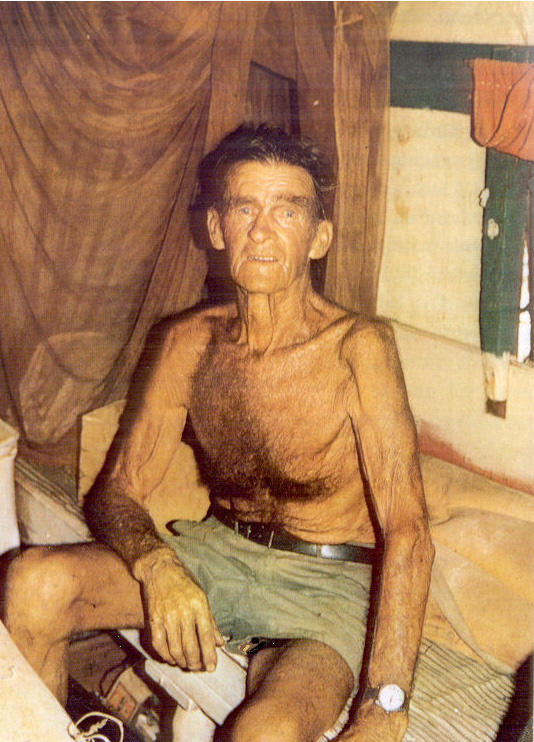
Gösta Brand

But Eino could produce evidence that this modern-day Swedish Robinson Crusoe existed. He had contacted the man's brother, a Viktor Brand, a farmer who had lived all his life on a farm in Simlångsdalen in Sweden. Viktor confirmed that he had a brother named Gösta who had left Sweden fifty-one years ago.

He had received the occasional short letter and card from his adventurous brother. The last one had been postmarked "Thursday Island", but that was more than a year ago. He thought he had been sick. Maybe he wasn't even alive any more.

Just in case we ever got as far as Thursday Island and found our modern-day Swedish Robinson Crusoe, we recorded a greeting from Viktor on Eino's tape recorder.

Thursday Island was almost as far away from Sweden as one could get. Our first stop after a long international flight was Sydney in Australia, then a domestic flight to Horn Island in the Torres Strait between Australia and New Guinea. Then a short ferry ride across to Thursday Island. (There was also a Friday Island nearby which made me think of Robinson Crusoe again) We had brought with us the cassette recording of Viktor's greetings and a bunch of family photos.

The community on Thursday Island was as large as a Swedish fishing village. It reminded me somewhat of Byxelkrok on the island of Öland. The population consisted mainly of coloured people, not Australian aborigines but South Sea islanders from Melanesia. There were no racial barriers as there seemed to be on the Australian mainland.

Inside the Federal Hotel

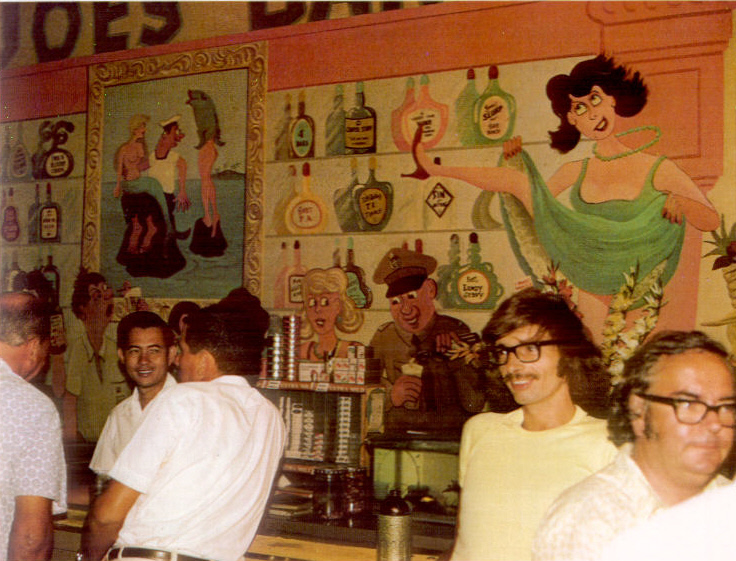
On our very first evening on the island we freely mixed with snooker-playing and beer-drinking blacks and whites alike in the hotel bar and were able to ask questions about Gösta. Nobody knew a Gösta Brand but they had heard of an old Swede called Ron Brand who lived on Packe Island, an hour away from Thursday Island by fast boat. But he was supposed to be seriously ill, and nobody knew if he was still alive.

Next day the postmaster confirmed that Ron was identical with Gösta - Gösta had simply been too difficult to pronounce for the local people. Two hours later we were on our way to Packe Island in a small boat owned by a South Sea Islander. About twenty minutes into our bumpy ride he yelled, "There is his boat! I am sure he is on it!"

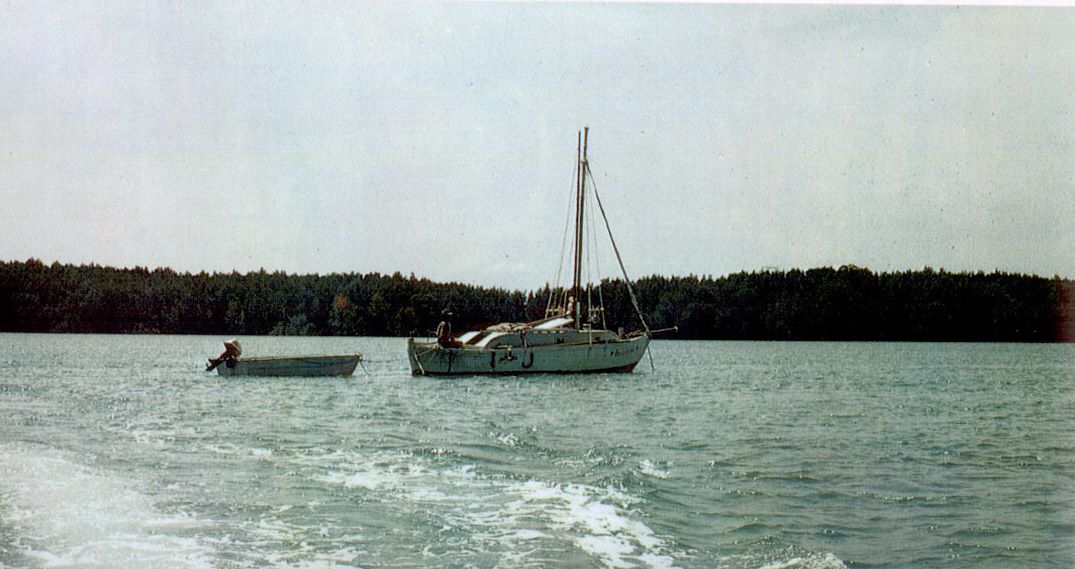
Ron on his boat

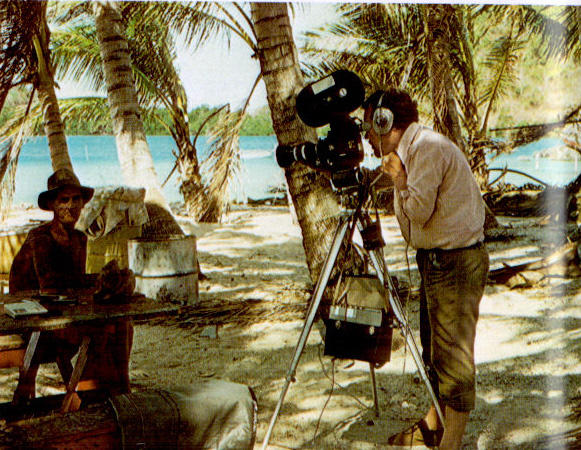
At the risk of capsizing our little dinghy and turning us into shark-food, Eino took out his camera and started filming. The boat, an average-sized sailing boat with an auxiliary motor and a dinghy tied to her stern, lay at anchor a few hundred metres off Horn Island. We spotted the bare torso of a man inside the cockpit who disappeared into the cabin as we approached.

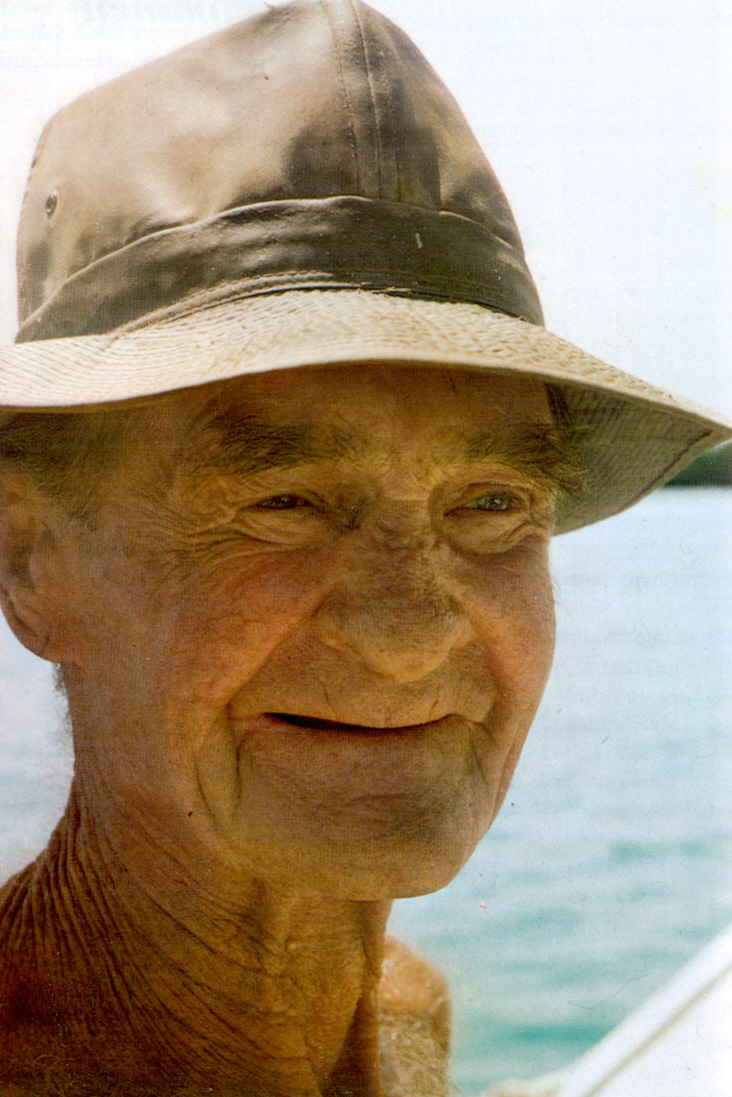
"I think he is sick," mumbled our boatman. However, as we got closer, he re-appeared from the cabin and we saw an emaciated, wiry, brownish man wearing a slouch-hat as protection against the sun.

I called out in Swedish, "Are you Gösta Brand? We have come from Sweden to bring you greetings from your brother Viktor."

He answered in a mixture of Swedish and "Sailor's English." Yes, he was Gösta Brand. He lived on Packe Island but had anchored his boat here because he was ill and had wanted to come a bit closer to civilisation. He thought it was his lungs, but he wasn't interested to go to a hospital. And he definitely didn't want our help to return to Sweden!

" I would die on the spot," he laughed. "I have lived far too long in the tropics. If I should die, it has to be on my island or on the boat here."

He was friendly and happy and not at all unsociable as we had anticipated. We suggested that he should follow us out to his island, so that we could film him there. He didn't seem unwilling but was probably too sick to be in front of a camera and also afraid of leaving his boat. With the help of a bottle of whisky
he finally agreed to wait for us until the next day when we would come back in a larger boat to tow him back to his island.

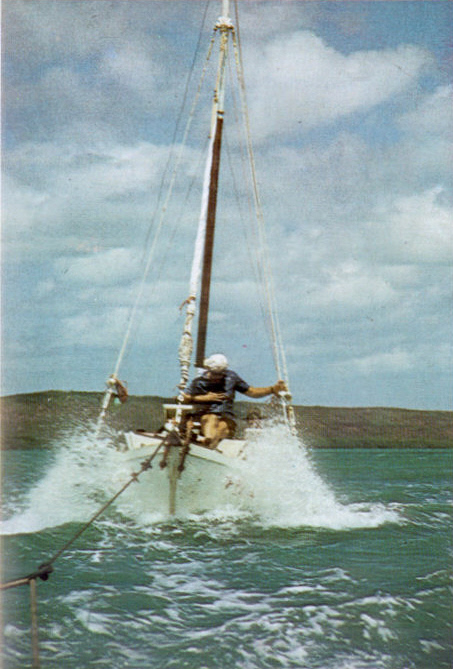
Towing Ron's boat

Next day we managed to hire a twin-engined speedboat that bounced along at more than 30 knots. I helped Ron lift the anchor and sat next to him in his boat while we were towed out to sea, with Eino filming from the speedboat. It turned out to be a more dramatic film than we had anticipated as the waves became bigger and wilder until they completely drenched us and filled the dinghy with water. Close to capsizing, we desperately waved our arms to tell the speedboat to turn back.

We were wet, depressed and angry as we dropped Ron and his boat back in the same spot where we had found him. So much for our efforts to film this modern-day Robinson Crusoe's existence on his tiny island!

I don't know whether it was the influence of the whisky or the prospect of appearing on Swedish television but suddenly Ron did agree to leave his boat and come with us to his island in our speadboat. "As long as you bring me back here afterwards," he said.

Ron's hut and beach

An hour later, after having passed other deserted islands, we stepped ashore on a South Sea island straight out of a "Boy's Own" setting. The calm waters of the bay in front of Packe Island were absolutely clear and blue, and the sand was soft all the way up to the palm trees. Palm trees that Ron had planted himself while he had built his hut and the bamboo fence surrounding it. The hut was painted white and had a roof of corrugated metal. For almost twenty years he had lived here totally alone after having cleared a piece of land and the beach in front of it. For all this he paid a peppercorn rent of ten dollars a year to the Australian government.

He regretted that a group of cultured-pearl farmers had moved in at the other end of the bay. We thought he would have welcomed having some other people nearby but he regarded them as trespassers on his island.

Gösta being filmed by Eino

He told us about the many adventures he had had and showed us some nasty scars on his legs from crocodile bites. He had become an Australian citizen and for the last few years had been getting a government pension which took care of all his material needs. But he still went crocodile-hunting on occasions or fished for barramundi, always accompanied by a native from one of the other islands. "They are my best mates," he said.

On the beach sat his canoe, named "Minnehaha"", meaning "Laughing Water" in some Red Indian language. Yes, he had lived amongst Red Indians, too. That was in Canada, before he came to Australia.

"Why did you choose this life?" we asked.

Gösta inside his hut

"Because I love my liberty!" he answered quickly and without hesitation. He had obviously considered this question many times.

"Didn't you ever miss a woman?"

"Yes, of course, but then I also have to get hold of a woman. I have never lived with a woman. I love my liberty!"

It sounded self-assured but by the time we had finished our filming and were to leave, we thought we knew the price he had paid for his freedom - what he called his "liberty" - and his carefree existence. He had seemed strangely touched by our visit as we recorded his message to his brother in Sweden.

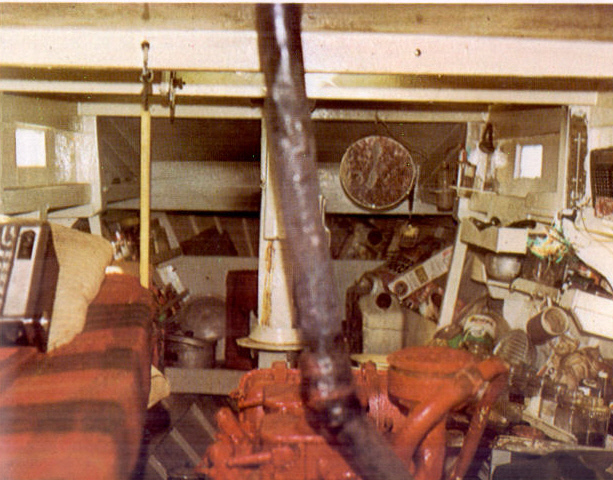
Inside Ron's boat

"You are both welcome to come back and stay on my island," he said as we were about to depart. "Bring your wife and kids with you."

We could tell that he meant what he said although he knew quite well how unlikely another visit would be. Not many people ever come this far.

I had one last look into the cabin of his boat before I climbed down the rail. There were three guns, two with telescopic sight, a cracked mirror, an old radio, some cans and a pair of old-fashioned spectacles. The sum total of his life, plus loneliness, hardship, and the occasional sickness.

As we left, the outline of where he sat in the boat waving goodbye was getting smaller and smaller. Very soon it would be hard to believe he existed at all.

But both Eino and I had the tooth of a crocodile he had given us to prove that he was real!


I had heard stories of people who wanted to visit him on Packe Island but he was anti-social and chased them away. Who was the man behind that wrinkled, mean old face? If what they tell us in books were true his long communion with nature and the surrounding sea should have taught him many subtle secrets. Or perhaps not. Perhaps he was nothing but a narrow, ignorant and cantankerous man who had turned his back on society. Perhaps those words in the Swedish article summed it all up:

"There were three guns, two with telescopic sight, a cracked mirror, an old radio, some cans and a pair of old-fashioned spectacles. The sum total of his life, plus loneliness, hardship, and the occasional sickness."


Googlemap Riverbend