If you find the text too small to read on this website, press the CTRL button and,
without taking your finger off, press the + button, which will enlarge the text.
Keep doing it until you have a comfortable reading size.
(Use the - button to reduce the size)

Today's quote:

Monday, September 7, 2026

Unsere neuen Nachbarn haben neue Nachbarn


Morgens schalte ich immer gleich zwei Dinge an: das heiße Wasser für eine Tasse Tee und den Komputer. Und dann wandere ich mit meinem Tee für eine Weile durchs taufrische Gras und überlege mir wieviel vom gestrigen Nichtstun noch unerledigt ist um es heute noch fortzusetzen.

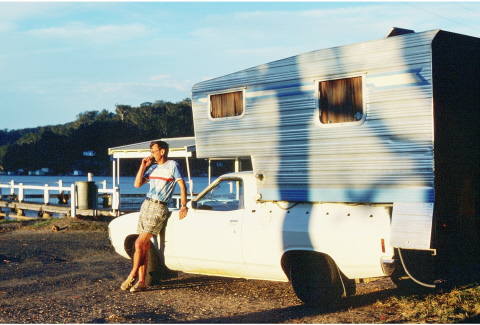
Ansonsten gibt es nichts Neues hier unten am Ende der Straße am Ende der Welt aber heute morgen sah ich diesen 'slip-on camper' vor dem Tor unserer neuen Nachbarn (naja, nicht ganz neu aber in den paar Jahren in dem sie schon hier sind, haben wir uns nur ein paar Male gegrüßt).

Seit ihrer Ankunft betreiben sie dort ein kleines 'Bed & Breakfast' und schreiben begeistert auf ihrem Blog: "... we love this part of Australia so much. It has taken us a lifetime to get here. Our search is over." Das war aber bevor sie die anderen Nachbarn kennenlernten ☺

Dieser 'slip-on camper' brachte gleich Erinnerungen zurück denn solch eine 'Brotbüchse' hatte ich mir in 1979 auch gekauft.


noch mehr Bilder


Damals war ich von meiner letzten Arbeit in Malaysien nach Australien zurückgekommen und hatte einen Posten in Canberra angenommen. Dann kam der Winter und die Wanderlust packte mich und ich fuhr los um dieses große Land zu entdecken. Allerdings fehlte mir das nötige Geld und so zog ich von Stadt zu Stadt um dort meine Dienste als Steuerberater und Rechnungsprüfer kurzfristig anzubieten.

Zuerst ging es nach Sydney, dann Mt. Isa, danach Mackay und Brisbane. Dann Melbourne und schließlich Townsville wo ich mich für länger festsetzte (fast ein Jahr; daß war damals eine Ewigkeit für mich!)

Alles gute Erinnerungen aber jetzt ist es Zeit für eine zweite Tasse Tee.


Googlemap Riverbend


A true story except for the parts that are not


"Declared open on 19th April 1987 by Mr Jack Myers
an employee engine driver & fireman of the Co.
from January 1937 to December 1973."


I discovered this little gem during another drive to Ulladulla when we strolled along the picturesque harbour to walk off some of the lunch we had overindulged in at the bowling club: pumpkin soup followed by a large Fisherman's Basket followed by a big slice of cheesecake with ice-cream.

Who was Jack Myers? Did he have any dreams and ambitions beyond being an engine-driver and fireman at Mitchell's Mill for thirty-seven years from January 1937 until December 1973?

Perhaps the point of this cumulative tale is Jack Myers' pointless life? Perhaps Jack Myers would've been engine-driver and fireman at that Mill much longer had it not been for the Mill's closure in 1974? Perhaps the highlight of Jack Myers' life is this plaque to his extraordinary ordinariness?

I don't know! And please, don't get me wrong: I am not knocking Jack! Jack and millions like him are the red blood cells that hold our society together. All I know is that nobody is going to put my name on a plaque for having lived the same year thirty-seven times over.

Which reminds me of a couple I used to know in Townsville - let's call them John and Elizabeth, because those were their names.

John had come here in 1957 as a young man, leaving his small country Austria to see the world. He took a job in Sydney and, on his first holiday, bought an old motorbike and rode north to explore Australia.

He got as far as Home Hill which, just a hundred kilometres south of Townsville and with a population of no more than a thousand at the time, was a backwater of a backwater.

John put up at the local pub where he met a young buxom barmaid who fell for his Viennese charm and accent, and they eventually settled in Townsville where John became the papercutter at the local newspaper.

He was still the papercutter at the local newspaper when I met them almost three decades later. By then, they had swapped their dreams of seeing the world for six kids and a small house in the suburbs. As Elizabeth wistfully remarked, "I married John in the hope of leaving Home Hill to see the world and I got as far as Townsville."


That was in 1985. Today the only plaque with John's name on it is in Townsville's cemetery. "Für immer in unseren Herzen." And in mine.


Googlemap Riverbend


Sunday, September 6, 2026

Red House


There is so much more in Hermann Hesse's "Wandering" - click here


Red House, out of your small garden and vineyard all the southern Alps breathe to me. I have walked past you several times, and even the first time my wanderlust was sharply reminded of its opposite pole; and once again I toy with the old refrain: to have a home, a little house in a green garden, stillness everywhere, a village below me. In a little room facing east my bed would stand, my own bed; in another little room facing south, my table; and there I would hang up a small, ancient Madonna which I bought on an earlier journey, in Brescia.

Like the day between morning and evening, my life falls between my urge to travel and homesickness. Maybe some day I will have come far enough for travel and distances to become part of my soul, so that I will have their images within me, without having to make them literally real any more. Maybe I will also find that secret home within me where there will be no more flirting with gardens and little red houses. To be at home with myself!

How different life would be! There would be a centre, and out of that centre all forces would reach.

But there is no centre in my life; my life hovers between many poles and counterpoles. A longing for home here, a longing for wandering there. A longing for loneliness and cloister here, and an urge for love and community there. I have collected books and paintings and given them away. I have cultivated voluptuousness and vice, and renounced them for asceticism and penance. I have faithfully revered life as substance, and then realised that I could recognise and love life only as a function.

But it is not my concern to change myself. Only a miracle could do that. And whoever seeks a miracle, whoever grasps at it, whoever tries to assist it, sees it fleeing away. My concern is to hover between many extreme opposites and to be ready when a miracle overtakes me. My concern is to be unsatisfied and to endure restlessness.

Red house in the green! I have already lived through you, I can't go on living through you. I have already had a home, I have built a house, measured walls and roof, laid out paths in the garden, and hung my own walls with my own pictures. Every person is driven to do the same - I am happy that I have once lived this way. Many of my desires in life have been fulfilled. I wanted to be a poet, and became a poet. I wanted to have a house, and built one. I wanted to have a wife and children, and had them. I wanted to speak to people and impress them, and I did so. And every fulfillment quickly became satiety. But to be satisfied was the very thing I could not bear. Poetry became suspect to me. The house became narrow to me. No goal that I reached was a goal, every path was a detour, every rest gave birth to new longing.

Many detours I will still follow, many fulfillments will still disillusion me. One day, everything will reveal its meaning."

These are Hermann Hesse's words (translated; they read even better in their original German) but they had such a personal resonance with me that I simply had to put them into this blog. Many detours I will still follow, many fulfillments will still disillusion me.

And isn't today Father's Day? I was reminded of it when I saw Father's Day cards on sale at K-Mart, six cards to a pack. A sign of our times?


Googlemap Riverbend


Saturday, September 5, 2026

Amusing ourselves to death


Every catastrophe needs its Jeremiah, and for the catastrophe of the rapid decline in reading we now have Times columnist James Marriott with his book "The New Dark Ages".

There was a time when literature was our religion. We explained and interpreted our lives by it. There was a time in Sweden even when the Lutheran Church banned the illiterate from marrying! We had a quote for everything and we could cross-reference our experiences against the novels of our nation's writers. You had William Shakespeare and I had Johann Wolfgang von Goethe.

Now classical allusions are gone and metaphors are treated literally by the dim-witted. We have TikTok and Twitter, which is limited to 140 characters. Imagine how Leo Tolstoy's "Anna Karenina" would end: "Alright, twenty rubbles says that I can toss my bag in the air, run across the tracks, and catch it before the train arriv... [This user's account has been deactivated.]"

I have ordered but not yet received James Marriott's book, but I did read Neil Postman's "Amusing Ourselves to Death", which anticipated the collapse of literacy with the coming of television. When the idiot box began to take off, life seemed to be reorganising itself around television’s centrifugal attraction. In living rooms across the world, armchairs and sofas were shifted around so that they no longer faced each other (as they had in most houses for most of history) and were directed instead towards the corner that contained the screen.


If you haven't read it yet, I recommend it to you. Unfortunately, there is no free online copy, except the German translation "Wir amüsieren uns zu Tode", which you could read if you were prepared to spend another lifetime learning German. Or you could listen to the audiobooks below:


Publisher's Introduction

Foreword

Chapter 1: The Medium Is the Metaphor

Argues that a culture's media (like the printing press or television) act as metaphors that implicitly dictate what kind of content and ideas can be expressed within that society.

Chapter 2: Media as Epistemology

Explores how different media define truth and knowledge (epistemology), asserting that a culture's concept of intelligence shifts depending on its dominant communication tools

Chapter 3: Typographic America

Examines early American history as a print-dominated society that prized deep literacy, complex arguments, and public intellectualism

Chapter 4: The Typographic Mind

Discusses how the printed word fostered a rational, orderly, and serious public discourse (exemplified by historical events like the Lincoln-Douglas debates)

Chapter 5: The Peek-a-Boo World

Explains how the telegraph and photography disrupted context by flooding public consciousness with fragmented, disconnected, and geographically irrelevant facts

Chapter 6: The Age of Show Business

Asserts that television has made entertainment the overarching format for all public communication, making reason and imagery incompatible.

Chapter 7: "Now . . . This"

Critiques the news and broadcast media, showing how rapid transitions and soundbites strip events of significance by teaching viewers to jump from tragedy to commercial without reflection.

Chapter 8: Shuffle Off to Bethlehem

Analyzes televised religion, arguing that when faith becomes a product designed for ratings, it is stripped of theology and transformed into hollow, comforting entertainment.

Chapter 9: Reach Out and Elect Someone

Explamines modern politics and political advertising, warning that candidates are packaged like consumer goods and political debates are reduced to superficial soundbites.

Chapter 10: Teaching as an Amusing Activity

Critiques educational television (like Sesame Street), arguing that it teaches children that learning requires no sequence, hard work, or exposition—only amusement.

Chapter 11: The Huxleyan Warning

Concludes by contrasting George Orwell's vision of a state-controlled society (Nineteen Eighty-Four) with Aldous Huxley's vision (Brave New World), warning that modern society is willingly surrendering its freedom through an addiction to amusement.


I hope you amuse yourself to death!


Googlemap Riverbend


No need for you to get jealous


Unfortunately, not all imagines are from Bonegilla


No one ever emigrates because of the success they've enjoyed at home. No one ever says, "Well, I have a happy home life, I'm rich and I have many friends - so I'm off." The only reason anyone has for going to live in another country is because they've cocked everything up in their own.

Being just nineteen years old, my opportunities for cocking things up had been rather limited by the time I left; in fact, my only - and certainly biggest - cock-up until then had been that I allowed myself to be born to parents who were so poor that they packed me off to work as soon as I had reached the minimum school-leaving age of fourteen.

But even those tough beginnings weren't enough preparation for what awaited me at the Bonegilla Migrant Centre, which might explain why I endured it for only two nights. In on 8 August 1965; out on 10 August.


My Bonegilla registration card
Find your own registration card at idcards.bonegilla.org.au


Between 1947 and 1971, more than 300,000 migrants — Greeks, Italians, Germans, Dutch, Ukrainians, Yugoslavs — stepped off ships from a ruined Europe and into an old army camp of tin huts near Albury-Wodonga. They learned English there, ate food they didn't recognise, waited for jobs that sometimes never came — and in 1952 and 1961, when the waiting broke them, they rioted. The country that invited them barely knew what to do with them. Then Australia moved on. The camp closed in 1971, the huts were bulldozed, and the place where a multicultural nation was born became a paddock again — except one block, saved at the last minute, which has become a memorial site.


The Memorial Arc at the old Bonegilla Migrant Centre


Bonegilla has remained a powerful connection for me even though I may never see it again. Instead, several years ago I lashed out two hundred and fifteen dollars to have my name added to their Memorial Arc. A small price to pay for my own twenty square inches of immortality.


No need for you to get jealous though: you already drew the winning ticket in the lottery of life when you were born in this lucky country.


Googlemap Riverbend


P.S. For more, go to My once-in-a-lifetime pilgrimage is still going ahead or If only those walls could talk ... or Wo ist Gerhard David?