If you find the text too small to read on this website, press the CTRL button and,
without taking your finger off, press the + button, which will enlarge the text.
Keep doing it until you have a comfortable reading size.
(Use the - button to reduce the size)

Today's quote:

Thursday, December 9, 2010

2011


Still recovering from my Sydney trip and tired out by the painting job, I went to bed last night even earlier than usual - nine-thirty is my usual bedtime! - only to stare at my bedside clock a few hours later, thinking I had woken up in the New Year and not at eleven minutes past eight!

Not to be caught out again, I've decided to start work on my New Year's Eve display. My friend Red Green has given me an excellent idea:


Beer o'clock and ale's well ...


... but not quite: as I had promised you pictures of the new fence at "Riverbend", I thought I had better 'grey-wash' it from top to bottom, end to end, and front and back.

I had just packed away my paint-brush, taken off my 'grey' clothing and opened a well-earned bottle when the rain came ...

I shall take some photographs as soon as I have painted the fence again and some green shots have come through the washed-off grey paint from the grass below the fenceline.

39 years ago!


On the 9th of December 1971, I appeared before Reserve Magistrate David Bruce Moorhouse in the old plantation house at Arawa on Bougainville Island in the then Territory of Papua New Guinea, to swear allegiance to Her Majesty Queen Elizabeth the Second, her heirs and successors, and to observe faithfully the laws of Australia and fulfil my duties as an Australian citizen.

And today, thirty-nine years later, after having paid many hundreds of thousands of dollars in income tax to the Australian Government, having incurred no more than a few speeding fines and parking infringement notices against my name, and never having asked for a single cent in Government assistance and even now in retirement living off my own investments and savings, I like to think that I have kept my end of the bargain and that the Australian Government got themselves a good deal in 1965 when they paid my fare out to this wonderful country.

I am proud to call myself an Australian and to call Australia my home, and to do so not through an accident of birth but because of my own deliberate decision and years of hard work!


Tuesday, December 7, 2010

ANZ ROCks!

left to right: Graham Wilson, John Burke, moi, Peter Bradford

After 43 years (!!!), I met three of my previous bosses at the ANZ Retired Officers' Club's Christmas function at the ANZ Bank's Headquarters at 20 Martin Place in Sydney.

We all were at the Bank's Canberra branch in 1967 where Graham (then Mr. Wilson to me!) was the accountant, John (then Mr. Burke to me!) was the Head Ledgerkeeper and my immediate supervisor, and Mr. Bradford (even today still Mr. Bradford) was the Assistant Manager.

I was just a lowly ledgerkeeper then on an equally lowly pay (the prepaid stamp duty on my bank account's cheque-forms in those days often amounted to more than the actual money held in the account).

It was good to talk with them - seemingly as an equal now but who knows? - about old times and old colleagues who couldn't make it. Some because they are too far away, others because they are too old, and then those who are still hard at it, such as the ex-teller who now runs the Goldfingers Nightclub in Melbourne - as tellers do after they've left the Bank's service!

As for Sydney itself, well, Banjo Paterson was right when he wrote about "the foetid air and gritty of the dusty, dirty city". It was not so much 'Hello Sydney!' as 'Hell O Sydney!' and I got it over and done with as quickly as I could.

Early on Monday morning I took the jam-packed commuter train across to North Sydney to briefly inspect the unit at McMahons Point (please note, dear ATO, there will be a tax deduction coming up!). The tenants wanted to know if I would like to sell. Would I? It's pre-September 15th, 1985 and thus pre-capital gains tax and every dollar by which it increases is tax-free!

Unit at McMahons Point - a small rathole but a great location!

Back to the Club for a quick shower and change.

My room with a view

Then a stroll up George Street past derelicts ...

Quite clearly not a German migrant


Old Bank of Australasia Building at Haymarket

... and the ANZ Bank's former Staff Training College where I once spent a week learning all about ledger-keeping. Today it's a pub. I drink to that!

More derelicts ...


... this one with enough initiative to have built himself a whole bedroom suite out of shopping trolleys and milk crates ...


... and past a dyslexic shop.

After stopping for a drink at Central Station where I took a picture to prove to Padma that the only "birds" I had been looking at were of the feathered variety ...


... I packed up to return to "Riverbend" and "the vision splendid of the sunlit plains extended.".

P.S. Since my first Christmas lunch with ANZROC, I have become a liitle more involved with them through setting up their blog.

Saturday, December 4, 2010

Every boy's dream come true


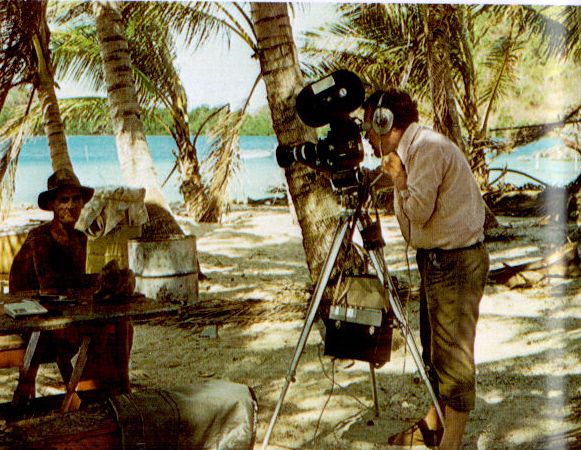
During my trip back to Thursday Island - see [here] - I heard of the story of a Swedish filmcrew who had visited Ron Brandt on Packe Island where he had lived as a recluse for many years. This is the filmcrew's narrative:


I was sceptical until the last moment.

It was Eino who had heard about him and had contacted the man's brother in Sweden who confirmed that the story was true.

He had read the story in a book by a Danish travel writer. It was about a modern-day Swedish Robinson Crusoe who was said to live alone on a tropical island to the north of Australia. A real Jack London figure who had left Sweden more than 50 years ago and had lived a life of adventure as a sailor, pearl fisherman, crocodile hunter and hermit.

"It sounds like a piece of fiction" I said. "That sort of things doesn't happen anymore. It's as dead as the brontosaurus. It's just the boy inside all of us that still dreams of such adventures."

Gösta BrandBut Eino could produce evidence that this modern-day Swedish Robinson Crusoe existed. He had contacted the man's brother, a Viktor Brand, a farmer who had lived all his life on a farm in Simlångsdalen in Sweden. Viktor confirmed that he had a brother named Gösta who had left Sweden fifty-one years ago.

He had received the occasional short letter and card from his adventurous brother. The last one had been postmarked "Thursday Island", but that was more than a year ago. He thought he had been sick. Maybe he wasn't even alive any more.

Just in case we ever got as far as Thursday Island and found our modern-day Swedish Robinson Crusoe, we recorded a greeting from Viktor on Eino's tape recorder.

Thursday Island was almost as far away from Sweden as one could get. Our first stop after a long international flight was Sydney in Australia, then a domestic flight to Horn Island in the Torres Strait between Australia and New Guinea. Then a short ferry ride across to Thursday Island. (There was also a Friday Island nearby which made me think of Robinson Crusoe again) We had brought with us the cassette recording of Viktor's greetings and a bunch of family photos.

The community on Thursday Island was as large as a Swedish fishing village. It reminded me somewhat of Byxelkrok on the island of Öland. The population consisted mainly of coloured people, not Australian aborigines but South Sea islanders from Melanesia. There were no racial barriers as there seemed to be on the Australian mainland.

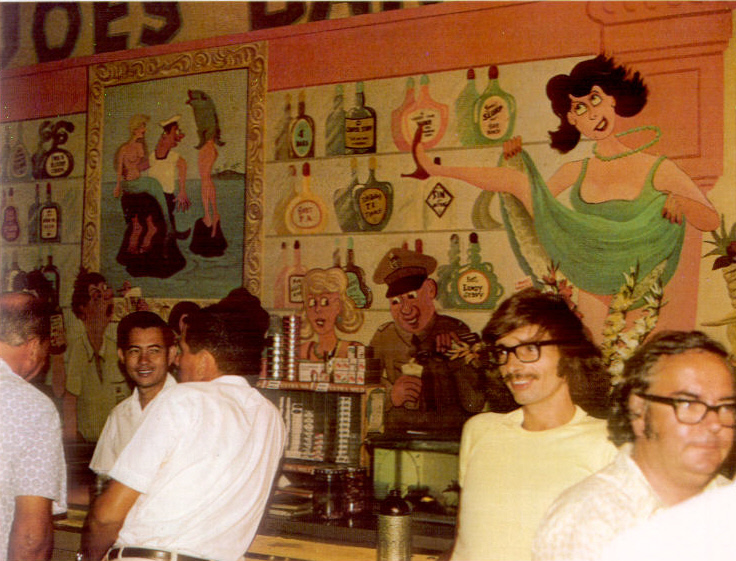
Inside the Federal HotelOn our very first evening on the island we freely mixed with snooker-playing and beer-drinking blacks and whites alike in the hotel bar and were able to ask questions about Gösta. Nobody knew a Gösta Brand but they had heard of an old Swede called Ron Brand who lived on Packe Island, an hour away from Thursday Island by fast boat. But he was supposed to be seriously ill, and nobody knew if he was still alive.

Next day the postmaster confirmed that Ron was identical with Gösta - Gösta had simply been too difficult to pronounce for the local people. Two hours later we were on our way to Packe Island in a small boat owned by a South Sea Islander. About twenty minutes into our bumpy ride he yelled, "There is his boat! I am sure he is on it!"

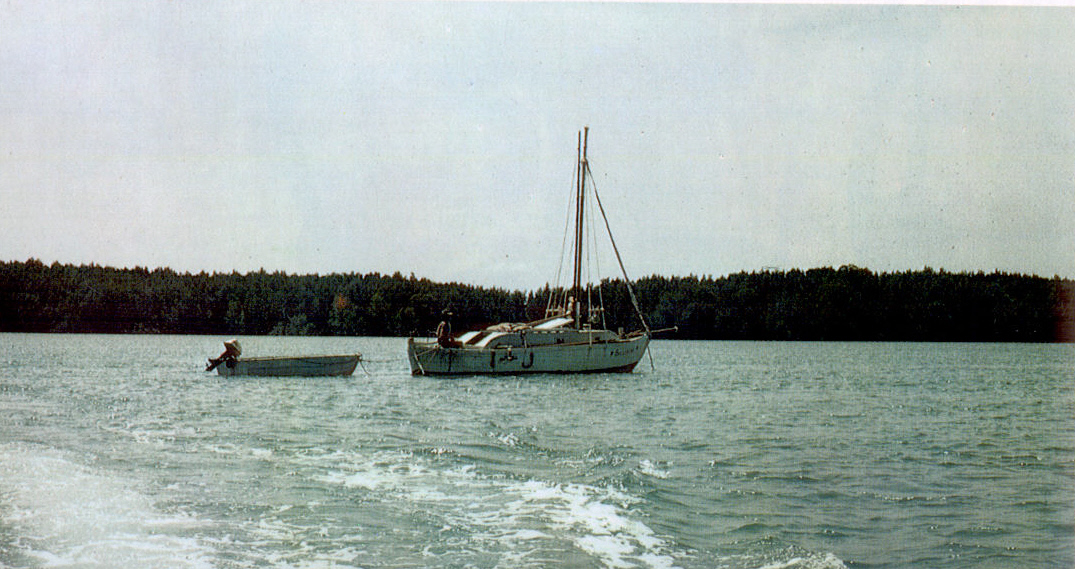
Ron on his boatAt the risk of capsizing our little dinghy and turning us into shark-food, Eino took out his camera and started filming. The boat, an average-sized sailing boat with an auxiliary motor and a dinghy tied to her stern, lay at anchor a few hundred metres off Horn Island. We spotted the bare torso of a man inside the cockpit who disappeared into the cabin as we approached.

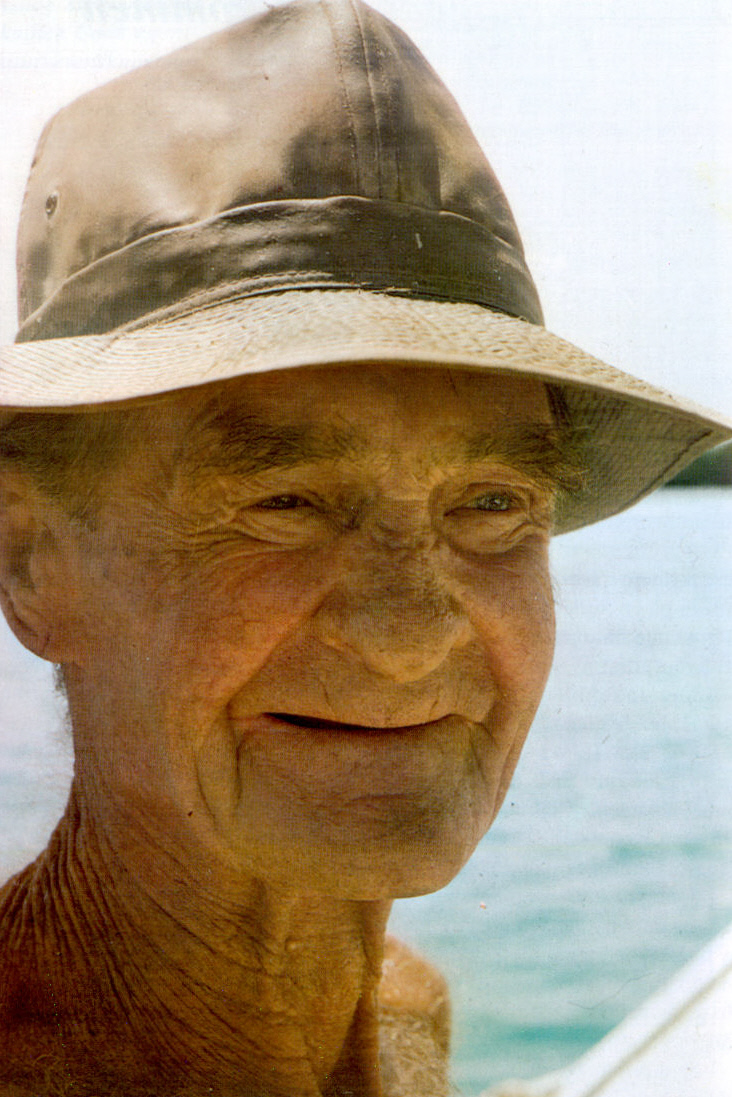
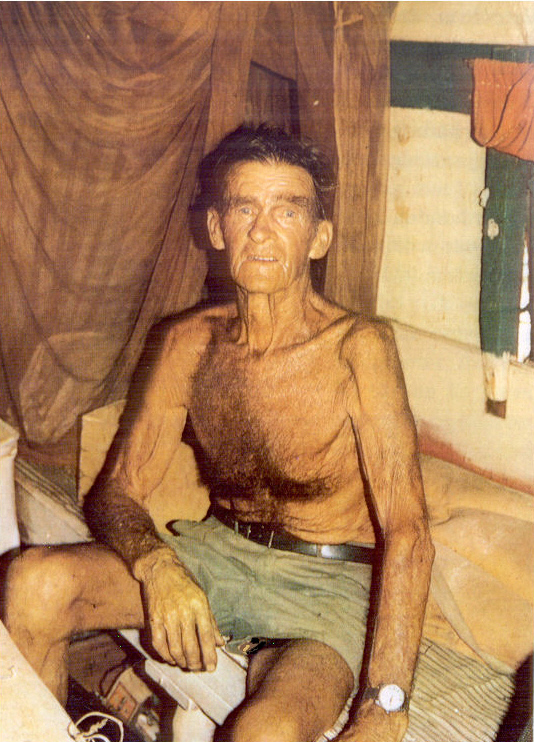
"I think he is sick," mumbled our boatman. However, as we got closer, he re-appeared from the cabin and we saw an emaciated, wiry, brownish man wearing a slouch-hat as protection against the sun.

I called out in Swedish, "Are you Gösta Brand? We have come from Sweden to bring you greetings from your brother Viktor."

He answered in a mixture of Swedish and "Sailor's English." Yes, he was Gösta Brand. He lived on Packe Island but had anchored his boat here because he was ill and had wanted to come a bit closer to civilisation. He thought it was his lungs, but he wasn't interested to go to a hospital. And he definitely didn't want our help to return to Sweden!

" I would die on the spot," he laughed. "I have lived far too long in the tropics. If I should die, it has to be on my island or on the boat here."

He was friendly and happy and not at all unsociable as we had anticipated. We suggested that he should follow us out to his island, so that we could film him there. He didn't seem unwilling but was probably too sick to be in front of a camera and also afraid of leaving his boat. With the help of a bottle of whisky he finally agreed to wait for us until the next day when we would come back in a larger boat to tow him back to his island.

Towing Ron's boat

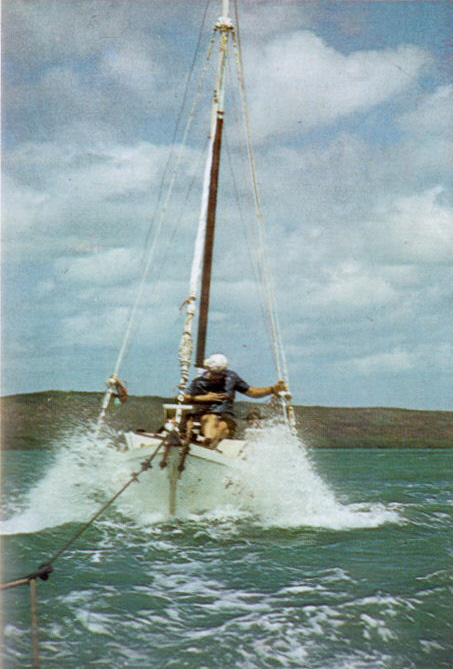
Next day we managed to hire a twin-engined speedboat that bounced along at more than 30 knots. I helped Ron lift the anchor and sat next to him in his boat while we were towed out to sea, with Eino filming from the speedboat. It turned out to be a more dramatic film than we had anticipated as the waves became bigger and wilder until they completely drenched us and filled the dinghy with water. Close to capsizing, we desperately waved our arms to tell the speedboat to turn back.

We were wet, depressed and angry as we dropped Ron and his boat back in the same spot where we had found him. So much for our efforts to film this modern-day Robinson Crusoe's existence on his tiny island!

I don't know whether it was the influence of the whisky or the prospect of appearing on Swedish television but suddenly Ron did agree to leave his boat and come with us to his island in our speadboat. "As long as you bring me back here afterwards," he said.

Ron's hut and beachAn hour later, after having passed other deserted islands, we stepped ashore on a South Sea island straight out of a "Boy's Own" setting. The calm waters of the bay in front of Packe Island were absolutely clear and blue, and the sand was soft all the way up to the palm trees. Palm trees that Ron had planted himself while he had built his hut and the bamboo fence surrounding it. The hut was painted white and had a roof of corrugated metal. For almost twenty years he had lived here totally alone after having cleared a piece of land and the beach in front of it. For all this he paid a peppercorn rent of ten dollars a year to the Australian government.

He regretted that a group of cultured-pearl farmers had moved in at the other end of the bay. We thought he would have welcomed having some other people nearby but he regarded them as trespassers on his island.

Gösta being filmed by Eino

He told us about the many adventures he had had and showed us some nasty scars on his legs from crocodile bites. He had become an Australian citizen and for the last few years had been getting a government pension which took care of all his material needs. But he still went crocodile-hunting on occasions or fished for barramundi, always accompanied by a native from one of the other islands. "They are my best mates," he said.

On the beach sat his canoe, named "Minnehaha"", meaning "Laughing Water" in some Red Indian language. Yes, he had lived amongst Red Indians, too. That was in Canada, before he came to Australia.

"Why did you choose this life?" we asked.

Gösta inside his hut

"Because I love my liberty!" he answered quickly and without hesitation. He had obviously considered this question many times.

"Didn't you ever miss a woman?"

"Yes, of course, but then I also have to get hold of a woman. I have never lived with a woman. I love my liberty!"

It sounded self-assured but by the time we had finished our filming and were to leave, we thought we knew the price he had paid for his freedom - what he called his "liberty" - and his carefree existence. He had seemed strangely touched by our visit as we recorded his message to his brother in Sweden.

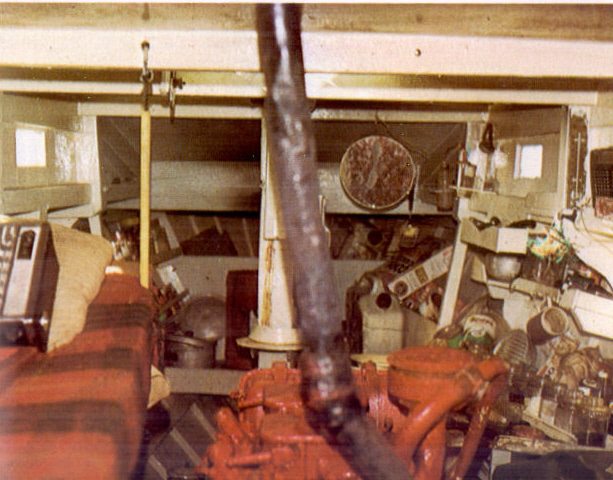
Inside Ron's boat

"You are both welcome to come back and stay on my island," he said as we were about to depart. "Bring your wife and kids with you."

We could tell that he meant what he said although he knew quite well how unlikely another visit would be. Not many people ever come this far.

I had one last look into the cabin of his boat before I climbed down the rail. There were three guns, two with telescopic sight, a cracked mirror, an old radio, some cans and a pair of old-fashioned spectacles. The sum total of his life, plus loneliness, hardship, and the occasional sickness.

As we left, the outline of where he sat in the boat waving goodbye was getting smaller and smaller. Very soon it would be hard to believe he existed at all.

But both Eino and I had the tooth of a crocodile he had given us to prove that he was real!


Shades of German Harry and French Joe and many other characters who had succumbed to the siren song of the Torres Strait. I had lived and worked on Thursday Island in 1977 and got out before I had gone "troppo".