If you find the text too small to read on this website, press the CTRL button and,
without taking your finger off, press the + button, which will enlarge the text.
Keep doing it until you have a comfortable reading size.
(Use the - button to reduce the size)
Most people, the vast majority in fact, lead the lives that circumstances have thrust upon them, and though some repine, looking upon themselves as round pegs in square holes, and think that if things had been different they might have made a much better showing, the greater part accept their lot, if not with serenity, at all events with resignation. They are like train-cars travelling forever on the selfsame rails. They go backwards and forwards, backwards and forwards, inevitably, till they can go no longer and then are sold as scrap-iron. It is not often that you find a man who has boldly taken the course of his life into his own hands. When you do, it is worth while having a good look at him." So begins W. Somerset Maugham's short story "The Lotus Eater" - keep reading here.
The title, of course, is a reference to an episode in Homer’s Odyssey in which the travelers encounter a land bearing lotus plants so irresistible that its visitors never leave, but the character was based on Maugham’s friend and lover, John Ellingham Brooks, who came to Capri as part of an exodus of homosexuals from England in the wake of Oscar Wilde’s conviction, in 1895, for "acts of gross indecency". Brooks, however, escaped the fate of Maugham’s character by marrying a Philadelphia heiress who, though she quickly divorced him, left Brooks an annuity that allowed him to live out his days on Capri, playing the piano and walking his fox terrier.
Maugham never approved of Brooks' indolent life in Capri, and wrote, "For twenty years he amused himself with thinking what he would write when he really got down to it, and for another twenty with what he would have written if the fates had been kinder."
I'm a fan of Maugham's writing and hope you find the story as fascinating as I did. As Maugham would have said, "Merci pour visiter mon blog!"
After my return to Australia in 1985, I tried to settle back into beachside suburbia at Cape Pallarenda just north of Townsville but the old magic of just walking back in and picking up from where I had left off had deserted me.
I eventually landed a job large enough for my ambitions in far-away Sydney, but not before I had made friends with two Townsville locals, Elizabeth and John, who at the time were the heart and soul of the budding German Club. I spent many happy hours at their crowded home in Railway Estate, with Elizabeth trying to encourage me to stay in town because, as she put it, "something always turns up".
Which was pretty much how she viewed the world because for her something - or someone - always turned up, just as twenty years earlier a young migrant from Austria on a round-Australia-trip had ridden his motorbike into Home Hill, a small place a hundred kilometres south of Townsville, and swept her off her feet. Not that everything went exactly to plan because, as she once wistfully remarked. "I married a migrant in the hope of seeing the world and got as far as Townsville".
Populate or perish: their family sometime in the early 80s
That migrant became her husband John who'd come out, just like me but eight years earlier and slightly older, as an 'assisted migrant' from his native Salzburg aboard the TOSCANA. Whether six children had been part of his plan is unknown but it certainly fitted in with Immigration Minister Arthur Calwell's post-WWII rallying cry of 'populate or perish'.
I stayed in touch with Elizabeth and John, and briefly enjoyed their Austro-Australian hospitality again during a short visit in 1999 when I sold my house in Bay Street (click here), but, sadly, they have since passed away, Elizabeth in August 2004 and John in September 2015.
Reunited where they had started out from: the Home Hill General Cemetery
Thanks to them and their six children and many more grandchildren, Australia is not likely to perish, and nor am I likely to forget them. They were the salt of the earth with hearts of gold. May they rest in peace!
P.S. In their memory I obtained John's immigration details from the National Archives, and sent them to his children and grandchildren:
There isn't much that's really news: the two guys with funny haircuts still want to blow the whole world to smithereens, "Mutti" Merkel will get another four years to turn Germany into Germanistan, and Sarah Hanson-Young wants to bring 20,000 Rohingya refugees to Australia to be trained as brain surgeons. I don't mind the Royinga refugees so much; I just don't think they'll find enough brains in this country to operate on.
As for same-sex marriage, I'm not sure it's worth getting all upset about. I mean, I've been having the same sex for far more years than I'm able to remember and yet I don't goosestep in the street. So for a bit more 'uplifting' news, I leave you with this article from the New York Times:
Have a good weekend and don't forget the Aeroguard!
All that's left of the Marquis de Rays' utopian dream: a millstone in the jungle
New France’ was a utopian society founded in 1880 by the con-man Marquis de Rays on the island now known as New Ireland in the Bismarck Archipelago of present-day Papua New Guinea.
He launched this scheme in 1877 and soon hundreds of investors poured in money, and altogether 570 would-be utopian settlers joined up. The marquis deliberately misled the colonists, distributing literature claiming a bustling settlement existed at Port Breton, near present-day Kavieng, with numerous public buildings, wide roads, and rich, arable land.
Instead of finding this Utopia, the colonists, mostly French, German and Italian, found a swampy, malarial-infested wasteland, surrounded by cannibalistic neighbours. Some were killed while others died of disease and starvation before the survivors made their ways to Australia, New Zealand, other Pacific islands, or back to Europe. For the full story of Marquis de Rays’ audacious con, read "Utopian Fraud: The Marquis de Rays and
La Nouvelle-France".
All that's left of 'New France' today is the above millstone which is on display in neighbouring Rabaul and whose inscription reads, "This Mill Stone was landed at Port Breton, New Ireland, by settlers brought out by the Marquis de Rays Expedition in the year 1880. Salvaged and brought to Rabaul in 1936. Survived the Japanese occupation and Allied operations in 1942-1945".
All that's left of Robert Bryce's utopian dream: a washing machine in the jungle For more photos, click here (it's all in German but the photos speak for themselves)
‘New France' is arguably the biggest fraudulent utopian scheme ever perpetrated but, as they say, history repeats itself and the dream of a life of ease on a tropical island lives on unabated as evidenced by such phantom paradises as Robert Bryce's "Cocomo Village" in the Kingdom of Tonga. Since 2009 it has attracted close to a hundred dreamers from all over the world - see here - , none of them living there yet. And perhaps never will, although one young family has just moved into the jungle, complete with washing machine. Wife and kids have since left again, leaving hubby behind with the washing machine.
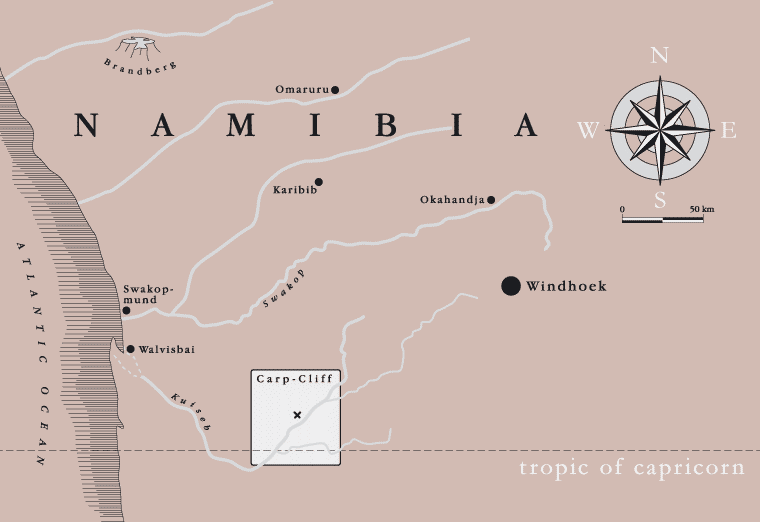
One of my favourite books is The Sheltering Desert by Henno Martin. It takes me right back to my own time in South West Africa and the Namib Desert.
Hanno Martin was born in 1910 in Freiburg, Germany, and lived in Göttingen again from 1965, and eventually died there on January 7th, 1998. In 1935 he left Germany together with his friend and colleague, Hermann Korn, to do geological research in South West Africa. At the outbreak of World War Two they fled into the Namib Desert, where they lived for two-and-a-half years.
The undescribable phsyical and mental hardship they had to bear, the challenge to survive in the vastness of the Namib Desert, the constant threat of detection and their gradual adaptation to live a life as ancient bushmen, while being confronted on the radio with the horrible clash of civilsations in Europe is described in this book, The Sheltering Desert.
Henno Martin wrote numerous scientific publications throughout his succesful academic career as a geologist. This is his only non-scientific work, an "autobiographic novel", a classical tale of escape and survival. Henno Martin continued to spend many years in Africa, where he worked as a scientist at the Geological Survey of South Africa and as professor at the University of Cape Town. From 1958 until 1960 he was professor at the University of São Paulo. In 1965, he became professor at the Institute of Geology and Paleontology of the University of Göttingen, where he also became a member of the Academy of Sciences.
Here is an excerpt from the book:
Forty years have passed since I, my friend Hermann and the dog Otto sought the shelter of the desert in order to escape the madness of the Second World War. We found the shelter we were looking for and we found adventures of survival which confronted us forcibly with the primitive traits of our own nature. Even after half a lifetime, the scenes of our desert existence are sharply etched into my memory, and every visit to the Namib feels like a return home. When I wrote this book twenty-seven years ago, the game which had provided us with food and joy was being wiped out by unscrupulous hunters. Now the »Carp Cliff« and its surroundings and the red dunes to the south of the Kuiseb canyon have been incorporated into the Namib Game Park, and it is a pleasure to record that springbok, gemsbok and zebra have recovered to some extent, and that at the Desert Research Station Gobabeb, on the lower Kuiseb River, scientists are studying the conditions under which life exists in this unique desert. Forty years ago, as Hermann and I lived like carnivores, whilst day by day the cruelties of the great war were brought by the radio into the serenity of our desert evenings, our thoughts and talks were much occupied with the riddles of the evolution of life and of man, of his astonishing cultures and his fateful failings. In the meantime, the dangers which we recognised then have grown and continue to grow at an increasing rate. Our deductions about the link between the complexity of human nature, with its capability for both sublimely altruistic and devastatingly destructive behaviour, and mankind’s evolution from primitive hunting families to competing warlike societies, seem to be as relevant today as they were during the great war. Readers interested in this aspect are referred to the late Robert Ardrey’s book The Social Contract in which the peculiarities and the innate dangers of human nature are traced to their animal roots. Many of our present troubles are aggravated by the prevalent socio- political theories which do not acknowledge the discrepancy that exists between the demands of modern societies and some parts of our hereditary make-up. By blaming all the evils of this world on its social structures these theories mobilise our inherited aggressiveness against other individuals, groups, races and nations, encouraging ever more costly combats with ever more disappointing results. It is essential to realise that a good part of the struggle for physical and spiritual survival has to be waged within ourselves against innate tendencies which, though once a condition of man’s evolution, have now become serious obstacles to our further existence and development. For me the most important gain of our life in the Namib was the experience that the human mind can rise above even the most savage conditions. Whether this faculty will enable us to master the avalanching dangers with which an unbalanced blind progress coupled with a grave misunderstanding of man’s nature are now confronting us, only the future can show.
The book, all 374 pages and 18 pictures of it, can be ordered from Two Books, Pilatuspool 11 A, 20355 Hamburg, Germany, for €12.80. Email service@twobooks.de or the Namibiana Bookdepot.
Ich wanderte im Jahre 1965 vom (k)alten Deutschland nach Australien aus. In Erinnerung an das alte Sprichwort "Gott hüte mich vor Sturm und Wind und Deutschen die im Ausland sind" wurde ich in 1971 im Dschungel von Neu-Guinea australischer Staatsbürger. Das kostete mich nur einen Umlaut und das zweite n im Nachnamen - von -mann auf -man.
Australien gab mir eine zweite Sprache und eine zweite Chance und es war auch der Anfang und das Ende: nach fünfzig Arbeiten in fünfzehn Ländern - "Die ganze Welt mein Arbeitsfeld" - lebe ich jetzt im Ruhestand in Australien an der schönen Südküste von Neusüdwales.
Ich verbringe meine Tage mit dem Lesen von Büchern, segle mein Boot den Fluss hinunter, beschäftige mich mit Holzarbeit, oder mache Pläne für eine neue Reise.
This blog is written in the version of English that is standard here. So recognise is spelled recognise and not recognize etc. I recognise that some North American readers may find this upsetting, and while I sympathise with them, I sympathise even more with my countrymen who taught me how to spell. However, as an apology, here are a bunch of Zs for you to put where needed.
Zzzzzz
Disclaimer
This blog has no particular axe to grind, apart from that of having no particular axe to grind. It is written by a bloke who was born in Germany at the end of the war (that is, for younger readers, the Second World War, the one the Americans think they won single-handedly). He left for Australia when most Germans had not yet visited any foreign countries, except to invade them. He lived and worked all over the world, and even managed a couple of visits back to the (c)old country whose inhabitants he found very efficient, especially when it came to totting up what he had consumed from the hotels' minibars. In retirement, he lives (again) in Australia, but is yet to grow up anywhere.
He reserves the right to revise his views at any time. He might even indulge in the freedom of contradicting himself. He has done so in the past and will most certainly do so in the future. He is not persuading you or anyone else to believe anything that is reported on or linked to from this site, but encourages you to use all available resources to form your own opinions about important things that affect all our lives and to express them in accordance with Article 19 of the Universal Declaration of Human Rights.
Everything on this website, including any material that third parties may consider to be their copyright, has been used on the basis of “fair dealing” for the purposes of research and study, and criticism and review. Any party who feels that their copyright has been infringed should contact me with details of the copyright material and proof of their ownership and I will remove it.
And finally, don't bother trying to read between the lines. There are no lines - only snapshots, most out of focus.
If you are looking for a particular blog, search here!
Come and read my other blogs (click on triangle for details)